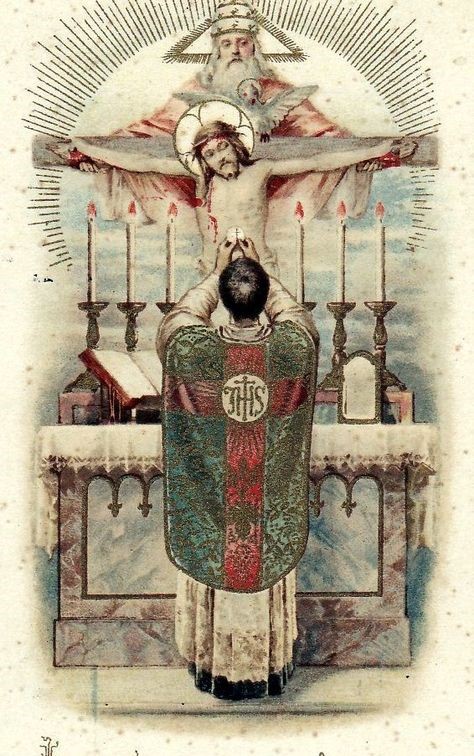
Aztecs, Sacrifice, and the Holy Mass

“The heart of Hummingbird Wizard!

The heart of Hummingbird Wizard!”

The crowd surrounding the pyramid erupts as the Aztec priest, with his hair turned black from dried blood, holds in his hand the still-beating heart of a man now lying motionless upon the stone altar.  The corpse is kicked down the side of the temple before it is eaten by bloodthirsty onlookers. A large snakeskin drum is beaten continually, booming out into the air, as another man is brought to the altar for his blood to be spilled.

sacrifice.jpg

The Aztecs were some of the most brutal killers to ever walk the planet.  Of all peoples to engage in the horror of human sacrifice, none were so terrible as these merciless savages.  On one account, as noted by Dr. Warren H. Carroll in Our Lady of Guadalupe and the Conquest of Darkness, 89-year-old Tlacaelel ordered the sacrifice of more than eighty thousand men over the span of just four days, for what amounts to the slaying of one victim every fifteen seconds.  Such a magnitude of evil is enough to make even a Planned Parenthood employee cringe.

Yet underlying this genocide is a strikingly profound reality.  The Aztecs offered these sacrifices to various gods who, according to custom, were glorified by such worship.  They believed that the gods might grant them favors if sacrifices were offered up in their names. This phenomenon is not exclusive to the Aztecs.  Remarkably, human sacrifice was present among nearly all prehistoric tribes as well. The Greeks and Romans offered animal sacrifice. Even the Jews, the inheritors of the true pre-Christian religion, in obedience to God, slew animals for adoration, thanksgiving, atonement, and petition.  People of cultures who never previously came in contact with each other all felt the desire to offer sacrifice. The inclination to not only reach out to the Divine, but to sacrifice something in recognition of our own dependence on Him is universal; it is inherent in man.

Aristotle said that man is the animal with reason; it can just as truthfully be said that man is the animal who worships.  Dogs do not pray for forgiveness after eating food off the table, and calves do not bow down before golden idols; only man recognizes a hole in his heart that natural pleasures cannot fill.  “The eye is not filled with seeing, neither is the ear filled with hearing” (Ecclesiastes 1:8).

Sacrifice has always been the practice at the very center of worship.  Just as we externalize the ideas in our minds with expressions on our faces and words from our lips, sacrifice is man’s outward manifestation of his desire for God from within.  

Ultimately, however, the practice of sacrifice recognizes a certain debt ingrained into the human condition.  Sacrifice can only be motivated by the sentiment that we truly owe something to the Creator.  Otherwise, there would be no reason for any such rituals.  Immolations serve as acknowledgements of God’s power over life, admitting the absolute ownership of existence to a Being beyond the constraint of death.  Man, on the other hand, is a slave to death. It is the one thing he cannot escape. He is a finite being with a longing for the infinite.

Our position could be compared to a man being chased by a hungry bear, as he comes upon the cliff of a mile-long chasm, left with the only options of jumping to his death or letting time take its course before being devoured alive.  He can leap and try to reach salvation, but unless a savior from the other side with a mile-long wingspan reaches out and grabs him, he will fall to the abyss of death.

“He is a finite being with a longing for the
infinite.”

Such is the case also with sacrifice; our attempts to reach God through the slaying of creatures cannot bridge the infinite gap between God and man.  The Aztecs were driven to offer as many sacrifices as possible in hopes to pay off this burden. They sought to cross that infinite chasm with the blood of finite men, but their “gods” were never satiated and their mortality never extinguished.

Men of all ages were imminently aware of this fallen state we find ourselves in, that by Divine Revelation we know to be the product of Original Sin.  The Sin of Adam and our own iniquities have placed us in this inescapable predicament that when left unaided leads straight to eternal damnation. Man is at fault, and only he can pay this infinite debt; yet man is finite, and such a debt can only be paid by the Infinite.  The Roman Catechism says that “the human race, having fallen from its elevated dignity, no power of men or Angels could raise it from its fallen condition and replace it in its primitive state.” If this is the whole story, then the only reasonable reaction is despair. No matter what we do or how we do it, we cannot climb out of this pit of death; “vanity of vanities, all is vanity!” (Ecc. 1:2). But this, we know, is not the full story.  

In the fullness of time, the Second Person of the Holy Trinity took on a human nature to offer the only Sacrifice that could heal this wound: Himself.  “To remedy the evil and repair the loss” that came from the Sin of Adam, the Roman Catechism says that “it became necessary that the Son of God, whose power is infinite, clothed in the weakness of our flesh, should remove the infinite weight of sin and reconcile us to God in His blood.”  True man, He bore the guilt of all humanity. True God, His Sacrifice alone had the efficacy to atone for all sins.

ihs.jpg

The privilege (and obligation) of the Roman Catholic is his or her ability to be really and truly present at that same Sacrifice that took place two-thousand years ago while at each and every Holy Mass.  The Mass is not a mere supper nor is it a community gathering for entertainment purposes; it is quite literally the unbloody unveiling of the Sacrifice of Christ that perpetually restores mankind to the Father and reorders the cosmos.  Our Lord intended to have this Sacrifice perpetuated in memory and for the application of its graces in every Church throughout the world until its consummation.

The incredible aspects of the Aztec sacrifices lay in the unlikely resemblance they had to Christian worship.  The Aztecs would paint and dress up their sacrificial victims to look like the gods to whom they were offered, so that they would have the “face of a god”.  They would even say that these victims were in the image of gods, so when they were killed it was like a god himself was offered up as a sacrifice.  As Catholics, we believe that “the Son is the image of the invisible God”, who offered Himself as a Sacrifice (Colossians 1:15).  The Aztecs believed they had to offer these finite sacrifices on a daily basis to appease the gods, whereas Catholics celebrate the One Infinite Sacrifice unveiled at Holy Mass every day.  With the guidance of brave Spaniards who risked their lives for the Glory of God, the Aztecs and other natives of Mexico ended up converting to Catholicism in rapid numbers because of these similar concepts in worship.  Instead of eating the legs or arms of the human sacrifices at the bottom of the temple each day, they could now eat the flesh of the God Who died in our place at Holy Communion.    

“True man. He bore the guilt of all humanity. True God. His Sacrifice alone had the efficacy to atone for all sins.”

Although it cannot be emphasized enough that the Aztec sacrifices were Satanic acts of wicked savagery, we can clearly see that their impulse - in some sort of odd way - was correct, just carried out incorrectly.  The rational faculty of man enables him to come to profound truths regarding God and His creation, as was seen with the Aztecs. Yet, in order to enter into communion with God, it is necessary that man submit to those Truths Divinely Revealed that cannot be reached by human reason alone.  The Aztecs and other natives converted to Catholicism in rapid numbers, largely because they recognized the Christian faith as the true end of some of their inclinations.

Unapologetically You

You know when you’re singing along to the radio and the words flow from your lips without a single thought? Perhaps you stop to think for a moment, then realize you just shouted an entire line of curse words with your mom sitting beside you. The same seems to go for the Mass as well: an entire group of people, standing in unison reciting the prayers, sitting, responding, maybe whispering along with the opening hymn - but are you really thinking about what you’re doing, or are you going through the motions? We repeatedly praise, worship, and direct our hearts towards our Heavenly Father; we literally speak the words “Our Father,” so why are we denying Him? As Christians, we must never be ashamed of Christ; we must never refuse the gift of faith given to us through Christ’s eternal single sacrifice.

What does that even mean? Now is when most get defensive, explaining how they go to Sunday Mass every single week (maybe except when the Super Bowl is on because… it’s the Super Bowl!) [Note: eyeroll]. They explain how they went to Catholic school for their entire lives; how they were baptized minutes after being born as if their 4-hour-old selves quoted the word of Peter: "Repent, and be baptized every one of you in the name of Jesus Christ for the forgiveness of your sins; and you shall receive the gift of the Holy Spirit" (Acts 2:38). That’s not to be minimized, for it’s true that the blessing of the faith lies within us all. As such, this article isn’t to say that you aren’t doing enough, although that is probably true. Rather, this is to raise the question of denying Christ.

Think about your father. Would you ever deny that he is your father? No matter what your circumstance may be, each one of us has a dad. Even if you don’t know him, or if he is your very best friend in the world, human beings feel a distinct connection to their biological parents. These two people, by the grace of God, created you in His image. Even if he fails to take into account your delicate sensibilities (yes, speaking from experience here...), one does not deny his or her father. Even if you don’t like him, chances are that you somehow love him. Surely, there is a difference between those two verbs.

Now, think of the last time you were standing in Mass, or most any Christian service for that matter. Perhaps without even thinking, the words begin to flow from your mouth: “Our Father, who art in heaven, hallowed be Thy name…” It does not take a Bible scholar to note that we are not talking about our biological father in this instance; rather, we are talking about our Heavenly Father, the one who commonly goes by the name of God, or Dieu if you’re French, Dios if you’re Spanish, and so on. It’s like that time that you were singing in the car with your mom, not considering what the words meant but saying them nonetheless. Crazy, truly.

As someone that did not grow up in this world where we discuss the change of saying “and with your spirit” instead of  “and also with you,” I noticed everything right down to its most basic level. In other words: I questioned everything like I was a two-year-old child asking “why” about quite literally every part of the Mass. Why did that person just do a little bow there in front of that table? (Note: I soon find that we call this the altar.) Why did that one person go down on one knee before sliding into his seat? (Note: this one was hard to grasp at first because genuflection feels like a dying ritual, but one that should most certainly be preserved). Why did that girl hug me at the Sign of Peace, and how many people do I have to awkwardly look at and mouth “peace be with you” until the priest continues? Everyone was speaking English around me, but they might as well have spoken a made-up language, for I was lost.

Since I’ve come from the secular world, my first time attending a Catholic Mass freaked me out. I felt as if I entered into an entirely different world, and despite the fact that the Mass was opened with the words “all are welcome here,” I most certainly felt out of place. Why are people singing now? What was that word that everyone just said in unison? Why does that person kneel while that one doesn’t? All these questions (and, trust me, many more) raced through my mind - and not just at my first Mass, but sometimes to this day. I had this feeling that everyone around me knew was was going on… except me. I felt a vague sense of unease whenever I would go to Sunday Mass because of that feeling, but I still needed to identify why, after eighteen years of existence, I decided that now was the time to explore Catholicism. Arguably, I had gotten along just fine before (or so I thought), but in seemingly minutes’ time, I felt like I could not live; I could not breathe one more day without giving myself to this Church. Because of all this, I found myself sitting in the office of Fr. Hayes to discuss the conversion process.

Per my typical “all or nothing” attitude, I quickly found myself attending daily Mass, running (yes, physically running) from meetings to Theology by the Slice so I could listen to talks on the Old Testament or Saints and Superheroes, and having breakfast with friends to talk about the faith. I went and bought my own Bible, which turned out to be an amusing and interesting experience as I tried to find out which translation was “best”... and which color I wanted. With such a dramatic change in who I was and who it seemed like I was becoming, friends and others around me began to take notice and give their “advice” on my new lifestyle. I was taking it too far, they said. “Perhaps she’s going to become a nun?” others remarked. Those who don’t know what Holy Cross is were convinced I had been sent to Bible school. Rival voices crept in from all directions, poking at me and making me question if the decision I was being called to make through the grace of the Holy Spirit was the right one for me. These voices came from some of the people I love most, making my “choice” that much harder… but that’s the thing: this isn’t a “choice,” because if it were, I could have easily decided to step away from the Church and return to my previous life. That life, however, was far gone.

“Faith is not a one-size-fits-all, and it is therefore going to look different for each and every one of us.”

Not wanting to be perceived as weird or anything too far out of our idea of normal, I cut back. I sometimes skipped Mass altogether, ultimately suffering and only hurting myself through that choice. I would take my cross necklace off around certain friends for fear of judgement. I would make excuses as to where I was going at 9 P.M. on Tuesday night, because who goes to Mass on a Tuesday? The answer: a lot of amazing people. Sometimes I feared that the aforementioned breakfast conversations about age-old debates of the Catholic Church would get so loud that nearby tables could hear. Without even knowing, and certainly without desire, I began to deny Christ. It was not until I listened to a podcast by Fr. Mike Schmitz that I realized what I was doing. [Note: if you haven’t listened to Fr. Mike, get ready for some life changing material.] Simply put, Fr. Mike outlines, “to deny Jesus will always be the wrong thing to do.” As much and perhaps more, we must care for our souls to the same extent we care for our bodies. This entails nurturing your relationship with Jesus and never being afraid (or ashamed) to accept him as your Lord. It entails not only acknowledging, but responding to the voice - the Holy Spirit - that is guiding you from within.

Faith is not a one-size-fits-all, and it is therefore going to look different for each and every one of us. With that said, it is time for us to show no fear or shame in our worship of God, which will mean different things for different people. Do you feel the call to kneel at Mass at the preparation of the Eucharist even though no one else is? Kneel. Do you love celebrating the Mass by singing? Let’s even get you a microphone! Is your ideal Wednesday night characterized by some pizza and theological discussions on the faith? Go eat pizza and open up your mind. The point is this: there will always be someone who doesn’t approve of you. Unfortunately for us, there is no such thing as a “good Catholic,” for at the end of the day, sin is to the human being as sacrifice is to the Mass, as Jesus is to the highest form of love.

If I had to describe the purest form of liberation, it would be the idea of being unapologetically you, which includes a fearless, shameless, loving worship and acceptance of Jesus. We would never want to deny our fathers here on earth, so why is it okay to deny our Father in Heaven? If it is of the unpopular opinion, so be it. If it is “weird” to unapologetically accept the utter gift of faith that has been given to us, let us be weird. Let us liberate ourselves from the shackles of fear and disappointment and step into a new life of love. All we can give to the Lord is our complete will. Offer it up. Accept your faith. Embrace the gift of acceptance, liberation, and life. Witness of the Mass is not enough; rather, we are called to participate in Christ’s sacrifice on the Cross. The urge to deny Jesus will always come, but Fr. Mike gives us the only answer we may ever need: “[rival voices] can rob us of peace, joy, and Christ’s place in our heart. But to take courage, get up, Jesus is calling you.”

“As Christians, we must never be ashamed of Christ...”

Letter from the Editors: February 2019

Dear Reader,

Thank you for picking up the first issue of The Fenwick Review of 2019.  We hope you didn’t mind the wait!  

This year marks the Review’s 30th anniversary.  Three decades ago, our publication’s founders vowed “to publish a journal of opinion” in which they hoped “to provoke intellectual discussion and stimulate ideas.”  Here, in 2019, we hold true to the mission they instituted and aim to advance the values, principles, and ideas they so boldly defended.

In 1989, 30 years ago, The Fenwick Review was founded on the defense of traditional Catholic principles and conservative ideas in order to provide alternatives to the dominant campus ethos.  The contents of this issue hold true to that mission. In the wake of continued campus controversy and student protest, Professor Schaefer of Political Science offers his insights on last December’s ENGAGE Summit and the foundations of liberal education.  Mr. Buzzard and Mr. Rosenwinkel reflect on living the Catholic faith and acting as a man for others, respectively. Mr. Klinker comments on the role of sex in the present-day culture, and Mr. Pietro defends American exceptionalism through historical and contemporary political contexts.

Though there is no doubt that Holy Cross is a different campus than it was 30 years ago when this publication first hit the newsstands, The Fenwick Review and its mission remain imperative and our founders’ vision remains relevant.  We seek the best for Holy Cross and hope you can find something to enjoy, to ponder, or to reflect upon in the coming pages of this issue.

Seamus Brennan & Michael Raheb

Co-Editors-in-Chief


The Problem With Asking More

Despite its blatant contradictions to Holy Cross’s mission statement, to Jesuit values, and to the objectives of Catholic education, the College’s “Ask More” tagline is decidedly appropriate for the current state of the school.  Rooted in fallacies and dangerous inconsistencies, the now five-year-old motto is not only a direct source of the College’s intellectual and cultural decline, but it has also fundamentally distorted the College’s mission as an educational institution – whether those behind the motto acknowledge so or not.  Because of the “Ask More” motto and its inevitable philosophical consequences, Holy Cross has devolved, on an institutional level, from a campus of higher learning to a campus void of answers, a campus void of lasting knowledge, and a campus void of truth.

In February 2014, Fenwick Review co-founder Fr. Paul Scalia said in an interview that his experience as a Holy Cross student could best be summarized as “the constant questioning, but never the articulation of an answer.”  Scalia continued: “Once we say the purpose of a college is to ask questions, […] that’s a huge problem.” As Scalia rightly noted, the act of questioning innately presupposes an answer; interpersonal dialogue in and of itself – both formal and informal – is contingent upon the existence of truth and an underlying desire to reach it.  But that’s not how many Holy Cross professors and administrators are inclined to approach their lectures and class discussions. Holy Cross’s version of ‘asking’ is not based upon seeking the truth or reaching a final conclusion, but on needless exposure and experimentation for their own sake.

The College’s “Campus Life” webpage suggests that “deep exploration” and the “uncover[ing of] new perspectives” are valued above all else.  The Montserrat program’s webpage indicates the program “encourages engagement” and “fuels an enduring quest” for “growth.” The Office of Diversity and Inclusion purports “the best way to understand the world around us is to embrace the full spectrum of perspectives and life experiences.”  And the list goes on. Several courses and seminars I have taken during my time at Holy Cross introduced students to a wide assortment of “perspectives” and “experiences,” but never once sought to analyze or dissect them, to dig deeper, or to – dare I say – answer any of the questions professors so tirelessly pose.  A multitude of perspectives can be noble and worthwhile, but only when presented in a way that compares and contrasts them – in a way that acknowledges their flaws and their fine points and isn’t afraid to elevate one over the other, or cast one aside because it might fall short. When teaching their classes, it seems many Holy Cross professors are consumed with following endless roadmaps with infinite numbers of twists and turns, divergent paths, and no destination anywhere in sight. Just as roadmaps might be deemed useless if they fail to direct one to a final destination, the act of ‘asking more’ is fruitless and meaningless when answers are abandoned and truth is left unacknowledged.  Asking without any intention of answering can only lead one down an eternal rabbit hole of uncertainty, indecision, and emptiness.

Unfortunately, the College’s apathy towards truth is not limited to the classroom.  The administration and student offices have taken up similar methods: the bleak intellectual consequences of ‘asking more’ have bled over to other components of the school and have further exposed the fallacious nature of one of the College’s most highly touted marketing slogans.  The Foundation for Individual Rights in Education labeled three of Holy Cross’s policies and codes of conduct as “red light policies,” indicating they are guidelines that “clearly and substantially restrict freedom of speech.” In its Use of Information Technology Services policy, for instance, Holy Cross leadership states that “the determination of what is obscene, offensive or intolerant is within the sole discretion of the College.”  Its Code of Student Conduct for Emotional Abuse denotes that “emotional injury” – for which the College offers no reliable definition – is considered a violation of community standards. Four additional rules and guidelines are categorized as “yellow light policies,” which the Foundation describes as having the capability to “easily be used to restrict protected expression.”

For a college that prides itself on “asking more,” encouraging “engagement,” and promoting an “enduring quest” for “growth,” aren’t free speech restrictions of any sort antithetical to the school’s mission and branding campaign?  If the “power of a question and the door it opens” is truly the “fundamental idea” behind the Holy Cross experience, as the school itself asserts, why should the College have the right to silence students based on what it subjectively perceives as “emotional injury” or “intolerant”?  If all ideas and perspectives must be acknowledged and discussed on equal playing fields, what gives the supposed champions of ‘asking more’ a right to shut them down? Here lies the problem with the morally relativistic and multicultural lenses through which the College is entrapped: if truth does not exist or is not worth pursuing, why should Holy Cross administrators have the right to tell one that his “perspective” is wrong or intolerant?  If all “perspectives” are equally valid and worth exploring, then why aren’t some? Perhaps most importantly, how does censorship of “emotional injury” complement one’s “enduring quest” for “growth”? The College that insists exposure to a multitude of perspectives is the basis for intellectual and personal growth should not be the College that flaunts its “sole discretion” to determine what might not be an acceptable perspective.  One cannot logically direct a body of students to “ask more,” but only up until someone’s feelings are hurt.

The “Ask More” tagline aptly characterizes the general academic and cultural atmosphere on the Holy Cross campus as palpably self-contradictory.  Of course, not every professor or every class abides by this faulty approach: intellectual honesty and appreciation for truth have not yet been not entirely terminated from campus, but they seem to be lessening every new semester.  Catholic Jesuit education is built upon pursuit of the truth. Holy Cross’s own mission statement, ironically enough, calls for “a passion for truth.” When will we start living up to it?

Truth is not always easy.  The quest for truth can be distressing, onerous, and at times downright infuriating.  But that doesn’t mean it’s worth forsaking. The act of ‘asking more’ is noble, but asking must lead somewhere or to something.  A restoration of meaning, purpose, and value would lead to immeasurable improvement and would do infinite good for Holy Cross’s campus.  As St. Ignatius Loyola, founder of the Jesuits, wrote, “It is not much knowledge that fills and satisfies the soul, but the intimate understanding and relish of the truth.”  In order for Holy Cross to live up to its strong potential as a Catholic liberal arts institution, it must shift from the pursuit of knowledge for its own sake to the pursuit of knowledge for the attainment of what is true and what is good.  Like truth itself, Holy Cross is worth protecting. It is in seeking the answer, not the question, that we can open our minds, revitalize our intellect, and reach our potential as a campus of higher learning.

To Live the Faith of Our Fathers

There is a stirring hymn by The Reverend Father Frederick William Faber from 1849 which, titled “Faith of our Fathers,” commemorates the sacrifice of the English martyrs that were killed under the Tudor rule of Henry VIII and Elizabeth I during the establishment of the Church of England. The martyrs include notable saints such as Saint Thomas More, Saint Oliver Plunkett, and Saint John Houghton, O. Cart. The hymn was written for the audience of both English and Irish Catholics, whose allegiance was found in their shared faith and persecution by an unjust authority. Its lyrics speak of how our Catholic faith is “living still in spite of dungeon, fire, and sword” which serve to remind the listener that the Catholic faith has and will continue to overcome persecution because of its truth. When performed on an organ, it is sure to have “our hearts beat high with joy whene’ver we hear that glorious word.” It should also serve as a reminder that the freedom to celebrate the faith openly is a luxury won after centuries of martyrdom. So, what does this hymn have to do with us as Catholics?

To start, reflection on the title of the hymn itself is important. For Catholics with a strong baptized lineage, it serves to remind us that this is indeed the “Faith of Our Fathers” in the literal sense of ancestry. There is a sense of pride here in being able to look back in our family trees and find solace in knowing that we are not alone in our faith. For converts to the faith, it is still important to look back upon spiritual fathers in the sense that many of the men and women who endured martyrdom for Christ were converts. There is the connection in the pursuit of truth, for while the two are not related by lineage, they are related in the sense that they are baptized into the Body of Christ. In both senses, this is a title which pulls on the heartstrings to invoke a sense of connection and a bond that transcends time.

In its composition, in order to properly honor the memory of the martyrs, there were important messages to give to the reader. The lyrics touch upon how “Our Fathers, chained in prisons dark were still in heart and conscience free: how sweet would be their children’s fate, if they, like them, could die for thee,” a message that may seem unfitting or uncomfortable for our modernity. We are called to remember that sacrifice that our predecessors made for us to be free. While chained, bloodied and bruised, these phenomenal men and women did not see this as their end, but rather they held out hope for Christ. Their hearts were purely intentioned because they were willing to give up their lives for the truth that they could pass on to future generations. How sweet it would be for us to honor their memory by making our hearts and consciences free due to our hope in the salvation of Christ! The call to martyrdom is not something that we will likely have to answer, due in part to the sacrifices of others. How can we, who have the luxury of having daily masses free from violent persecution, possibly “die for thee?”

This call is answered in the hymn and it can apply to our modern lives. The hymn is overwhelmingly a message of Hope. It is hopeful that we as Catholics will “love both friend and foe in all our strife: and preach thee too, as love knows how by kindly words and virtuous life.” We are called to love our friends and our enemies, preach the Word of God, and live a virtuous life. All of those things are extremely difficult to do and through human error we are likely to fall. In our shortcomings, we are never alone. We have Christ, His Church, the Communion of Saints, and many more aspects of faith available to us. Though this road is difficult, we can become more and we are commanded to do a better job.

How can I, a Catholic in college, do a better job? To start, remembering constantly that this is a faith for which people have shed their blood. To honor of the faith of our fathers, we should act like the Church that we are baptized into is the truth for which people would die to protect. It is not something to which only partial attention should be paid; rather, all of our attention should be towards salvation through Christ. We should seek to live out a virtuous life, one that is set in the virtues of humility, kindness, temperance, chastity, patience, charity, and diligence. When we falter in our pursuit of virtue, rather than scorning the Church, we must be reminded of the Faith, Hope, and Love found in Christ. We will never be perfect - no human being is perfect - but we have models that we can strive to imitate.

It is not enough for one to say, “Oh I went to a Catholic school” or to say, “Well, I was raised Catholic” in order to claim some authority as to why he is out of line in his views. Catholicism is a living faith. It requires faith and works and for its members to do more than sit in a pew with half-attention once a week. We need to do better, and to do so requires dedication and a willingness to pursue something more than ourselves. When our Church has a history of individuals who selflessly gave up their lives with their last words being “Deo gratias” (thanks be to God) rather than denying Him, it is not enough that we call ourselves ‘Catholic’ and then proceed to give up Christ for the other 167 hours of the week. In our daily lives, let us try to be better and actually commit to the centuries of foundation set before us.

“Faith of Our Fathers” is a very classic hymn with a timeless message. It is important that we pay attention to the lyrics whenever we are fortunate enough to hear it during Mass. In our Church, we have both genealogical and spiritual Fathers that we can follow in order to model our Faith. Being Catholic is not easy, but we have been afforded some luxuries that were not previously available to those before us. We have governmental freedoms that allow us to avoid being put to death; surely we can take advantage of that and use our time to glorify God. It is time to rock the cradle enough for us to fall out of our habits and become like our Fathers, who only sought to preserve the truth so that future generations would be able to worship our Lord freely.

On the Relation of Feelings, "Demands," and Reason in Liberal Education

This past November 11, in reply to the student/faculty letter demanding that the College cancel classes for as long as a week in response to an alleged "hate crime" (as well as to other alleged but unspecified incidents of bias-motivated "hate and violence")—a demand to which the College administration acceded in part by canceling all classes and extracurricular activities for an afternoon so that students and faculty could attend a mandatory "Summit" to address the issues raised in the letter—I arranged for the following notice (slightly edited here) to be posted on my office door. (Since I am currently on sabbatical, I wouldn't have been in my office on that date, nor even, I suppose, expected to participate in the Summit, but I thought it essential to make a statement regarding the significance of the shutdown,)

I have not signed the letter asking the College to suspend classes on account of a reported hate crime. This is because I believe the primary purpose of a liberal arts college is to engage in the pursuit of learning, through classes and the study of readings that are of lasting importance. So far as I know, Holy Cross maintained a regular class schedule even during the Second World War, when many of our students and recent alumni were abroad fighting for our country. We cannot afford to set a precedent of calling off classes whenever faculty and/or students are upset about some particular incident, however ugly it may have been. (I say "may have been" because the circumstances of this incident have not been made clear to the faculty, the student body, or the public at large.)

The foregoing statement elicited a remarkable response from a student I have never met, which she emailed to a dozen or so College administrators from the president on down, as well as to the chair of my department:

As I was passing through the hallway in Fenwick, I saw a very concerning letter from Prof. Schaefer posted outside of his office door. I felt like this letter is very inconsiderate and insensitive as it minimizes past and recent events that have been impacting many students, faculty and staff on our campus. It makes me feel extremely uncomfortable, especially coming from a professor, because I feel like this is disrespectful to those who have been affected by these events. I noticed on the ENGAGE Summit schedule, the Political Science department is hosting an Open House, and as a faculty member that represents that department, what he mentions in his letter contradicts the message the department is trying to put forth for tomorrow in their session.

Last year, I was the student that found and reported a swastika that was in one of my classrooms. It is extremely upsetting and disheartening to be in this position, as a student, to have to make reports like this–  but especially when they are coming from our own professors. Thank you.by [sic].

According to a report subsequently issued by the Office of Public Safety, it appears that no proof has been found of the alleged incident that provoked the mass letter calling for a suspension of classes. But whether or not the incident occurred is beside my present point. What centrally concerns me—as it did when I posted the "offending" message on my door—is the misunderstanding of the function of a liberal arts college, or the very meaning of liberal education, that is embodied in the original petition that led to the Summit; in the resultant cancellation of academic and extracurricular activities; and in the student letter I have quoted.

To anyone old enough to have been in graduate school during the late 1960s, as I was, the cancellation of classes has an ominous ring. That was the era in which students forcibly shut down college campuses, sometimes occupying academic buildings, even with weapons, for the sake of demonstrating their opposition to the Vietnam War, for racial "causes," or for other political agendas. (This occurred, most famously, at Harvard, Columbia, and [sadly for me] my own undergraduate alma mater, Cornell—where a supine University president was photographed squatting on a podium floor, soda can in hand, while a student "activist" railed at him before a large audience—this in preparation for the University's surrender to demands that punishments for rioting students, including those who had occupied the student union with guns, be canceled.) To those who possess some historical memory, the surrenders also recalled the sacrifice of the pursuit of learning to a radical political agenda that destroyed German universities in the 1930s.

By contrast, I am proud to say, my graduate alma mater, the University of Chicago, refused to suspend classes, or allow those who occupied the administration building to go unpunished. This isn't because many or most faculty didn't agree with the political beliefs of the protestors—regarding the war, race relations, etc.—but because at Chicago, then and now, the pursuit of learning is sacrosanct.

In this light, what is striking about the student's response to my notice is the expectation it exhibits that all professors (as well as students and administrators, presumably) should suspend their joint pursuit of learning, just in order to accommodate her (and other students') feelings of distress. If a professor's daring to dissent from the demand that classes be canceled makes her "feel extremely uncomfortable," I fear that Holy Cross has poorly prepared her to face the much more strenuous tribulations that adult life is likely to hold. To say that she "feels like" my dissent "is disrespectful" exhibits a significant misconception of what "respect" means, or to whom it is properly owed. Since when is it the job of professors to accommodate their students' "feelings," justified or not? How does she react if she is assigned a book in class that she disagrees with? (Does she require a "trigger warning," if not the removal of the offending text?)

The proper function of liberal education, as understood from as far back as Plato and Aristotle through such nineteenth-century champions as Matthew Arnold and John Henry Newman (and in the twentieth century, University of Chicago president Robert Maynard Hutchins), isn't to accommodate learners' feelings, but to challenge their received opinions or prejudices on the basis of rational arguments and free debate. Apparently, none of the letter writer's teachers thus far have got this message through to her—perhaps because they themselves, like the Baby Boomer protestors of the 1960s (or their predecessors, German youth of the 1930s) don't really believe in the superiority of rational thought to political advocacy based on mere emotion. If this is so, then they have been failing in their vocation.

(As an aside, I must observe with great regret the egregious recent discoveries of individual faculty sexual misconduct towards students, two of which have recently been acknowledged by the College administration. In that regard the third of the complaints submitted by "@sexualassaultonthehill" subsequent to the Summit urgently merits firm administrative action—although not another suspension of classes that would only divert attention from the real problem. Nonetheless, the fact that the complaints are listed as "demands" exemplifies a distorted understanding of the proper relation of students to College faculty and administrators as a whole—eerily reminiscent of the assaults on Chinese professors and teachers in the 1960s under the auspices of the government-sponsored, terrorist "Cultural Revolution." Additionally, the sixth "demand"—that the College "protect" self-identified student "survivors" from Secretary of Education Betsy Devos's proposal that accused perpetrators of sexual abuse "be able to hire a separate investigator to cross-examine" their accusers—bespeaks an ominous disregard for the Anglo-American tradition of due process of law, recalling the Salem witch trials. Will administrators and faculty have the backbone to stand up against such lawlessness?)

I close this essay by mentioning that as a Jew, I would have had far more reason than the letter writer to be offended or even upset at the discovery of a swastika on campus. However, it would never have occurred to me to respond by demanding that classes be suspended in consequence. To do so would play into the hands of those who seek to suppress rational debate, as well as respect for legitimate differences of opinion. (On the other hand, judging from my long acquaintance with Holy Cross students, I would guess that the swastika was far more likely a stupid prank provoked by the College's ever-increasing barrage of "multicultural" indoctrination than a reflection of Nazi sentiment.)

I earnestly hope that the suspension of classes is not an event to be repeated. And I urge the letter-writer to take some challenging classes in which classic, difficult texts— philosophic, literary, historical—are read closely with a view to understanding what their authors have to teach us, rather than judging them by the standard of our own pre-existing "feelings." What else is liberal education—the education that is supposed to equip a human being for genuine freedom, with reason governing rather than serving the passions, and with respect for the rule of law—for?

Dancing With Your Eyes Closed

In my first year as a resident assistant here at the College of the Holy Cross, I was given the opportunity to participate in an event called “Pie Your RA.” “Pie Your RA” was relatively self-explanatory: at a specified time in front of the Hogan Campus Center, residents could purchase, for a dollar, a whipped-cream “pie” and promptly deposit it onto their garbage-bag-clad RA’s face. I, ever being a jokester, was all-for the event. The donated monies would go to benefit the Holy Cross Dance Marathon, wherein students dance the night away (literally, mind you – they dance all night) to raise money for the Elizabeth Glaser Pediatric Aids Society. What could go wrong?

To make a long story short: once I knew what I’d be getting into, I didn’t let one drop of whipped cream touch my face.

The Dance Marathon has been waltzing around the College since 2012. A Holy Cross alumna co-founded the event during her senior year, according to her blog “A Job Well Dunn,” for the sake of “bringing students and the community together to raise money and awareness for the Elizabeth Glaser Pediatric AIDS Foundation.” During the initial year, the Marathon raised almost $24,000 for the Foundation; in the next year, the number increased by roughly $4,500. It seems that the donations peaked in 2014, where an enterprising group of students raised over $40,000, although the amount has dwindled to back around $27,000 as of last year. (The Campus Activities Board hosted the event again on January 25th, but I haven’t found the total amount donated this year.)

I suppose that these numbers indicate how easy it is to say to a group of students: “hey everyone! Let’s all dance together, have a fun time, and save the lives of some children suffering from HIV/AIDS! Everyone wins!” and have an overwhelmingly positive response. It makes sense, to be sure; who wouldn’t want to protect the lives of children? Who wouldn’t want to purge HIV and AIDS from the world? Noble, to be sure.

But the “everyone wins” is false. The children don’t all win, nor do their mothers, nor do we. The Elizabeth Glaser Pediatric Aids Foundation, despite what it seems, is unadulteratedly pro-choice; furthermore, it disagrees fundamentally with Catholic sexual ethics.  Frankly, I don’t know if Holy Cross itself knows that, and I’m sure that most of the students who attend the Dance Marathon don’t know either.

The Lepanto Institute for the Restoration of All Things in Christ, a “research and education organization dedicated to the defense of the Catholic Church against assaults from without as well as from within,” marks the Elizabeth Glaser Pediatric Aids Foundation (EGPAF) as “Not Safe” on the grounds that it facilitates abortion and contraception. On a page dedicated to explaining this grade (see https://www.lepantoinstitute.org/elizabeth-glaser-pediatric aids-foundation/), they explain why. EGPAF, in 2013, published a progress report on its “Cote d’Ivoire” project in Kenya. “Page five of this report,” claims Lepanto, “clearly indicates that its distribution of 400,000 condoms was one of its accomplishments for just one year.” Indeed, on page five of the PDF document linked to the Lepanto webpage, the statement “Over the year, EGPAF distributed over 400,000 condoms” appears. Please note that section 2370 of the Catechism of the Catholic Church explains that “every action which... proposes, whether as an end or as a means, to render procreation impossible is intrinsically evil.” This prohibition includes condoms, which render procreation impossible.

Perhaps far worse is that EGPAF also supports abortion. According to the Lepanto Institute, EGPAF celebrated the repeal of the Mexico City Policy in 2009. The policy requires that nongovernmental organizations must, in order to receive federal funding, not involve themselves in family planning via abortion in other nations. The Mexico City Policy has vacillated, being repealed and reinstated, over various presidencies and was repealed under President Obama, although Trump has recently reinstated it again. The EGPAF’s support of Obama’s repeal can be affirmed by a statement from Pamela W. Barnes, the President and Chief Executive Officer of EGPAF in 2009. She commented that “the prevention of unintended pregnancies is one of the four cornerstones of the United Nations’ and World Health Organization’s strategy for preventing mother to child transmission (PMTCT) of HIV.” Barnes also noted that “the ‘Mexico City Policy’ denied funding for these basic family planning services.” In a 2014 report (after the Dance Marathon had already begun donating to the Foundation), the EGPAF noted that it provided “key results in prevention of undesired pregnancies: EGPAF-supported programs provided family planning counseling and methods to 11,678 HIV-positive individuals in 2014.” As noted by Barnes, that counseling includes abortion.

Although most people are well aware of the Church’s stance on abortion, I’ll include some of Pope St. Paul VI’s words on the subject; he is, after all, a saint. And a pope. And a magisterial authority. In section 14 of his encyclical Humanae Vitae, he comments that “above all, all direct abortion, even for therapeutic reasons, (is) to be absolutely excluded as lawful means of regulating the number of children.” I suppose that’s firm enough for me to say and be done with the subject. EGPAF is, consistently and objectively, in opposition with the teachings of the Catholic Church and anyone who holds pro-life ideals. Ironic that an organization so concerned with healthy children has no qualms with killing those unborn.

What’s more ironic? Last year, despite how a quick Google search determines that EGPAF isn’t a Catholic-friendly charity, a Mass collection was held for the group around this time. I’d been sitting in a pew with a close friend, fishing for my wallet as the collection basket floated down our way, whispering to him “shouldn’t you be donating to help stop pediatric AIDS?” His retort: “for the good of your soul, you’d better not donate to them.” I stuffed my wallet back into my pocket and passed the basket along, all the while mildly confused with his sentiment (until I learned the truth about the Elizabeth Glaser Pediatric Aids Foundation, of course).

Now, what of those other Catholics and pro-life students among us who danced the night away with the Dance Marathon this year? Holy Cross has done them a disservice by making the Marathon into a celebratory festival where the goal is promoting life, albeit quietly at the expense of other lives waiting to be born. Over the course of seven years, the truth about EGPAF has, as far as I’m aware, never come to light. I’d almost be amused if it weren’t so terrible.


American Exceptionalism: The Nation's Binds

The Hague, America, a unique country on the world stage, is truly a gift to humanity. The world as it stands today exists only because of the awesome power of the United States and its diverse people. American Exceptionalism – the aggregate of values and traditions that makes the American identity – undergirds America’s social structure and binds the nation together, enabling the United States’ strength. American identity is heavily influenced by classical Western identity, and thus the two can not be completely separated.  The Judeo-Christian values of individualism, equality, and charity underpin American strength and generosity and solidify the country’s character. Formidable constitutional protections – unprecedented prior to America’s founding – sustain the freedom that personifies the United States’ international image. A firm historical record of overcoming adversity and championing freedom provides a distinctive legitimacy. However, in the 21st century, there is an increasing percentage of Americans who see the U.S. in a negative light, shunning past achievements and viewing the U.S. as fundamentally flawed. A loss of faith in American exceptionalism risks the collapse of the democratic world order.  

Judeo-Christian values have, from the very start, fashioned the basis of American behavior. The Pilgrims came to America seeking the freedom to practice their faith, and many subsequent colonial settlements followed suit; be they Rhode Island as a home for disparate religious groups or William Penn’s Quaker Pennsylvania, Judeo-Christian faith was the heart of what would become America. Likewise, the Founding Fathers recognized the indelible importance of faith in society. George Washington stated: "Of all the dispositions and habits which lead to political prosperity, religion and morality are indispensable supports.” Alexander Hamilton also saw value in faith and God: “The sacred rights of mankind... are written... by the hand of the Divinity itself, and can never be erased or obscured by mortal power.” Finally, even Adams spoke of their importance: “And what were these general Principles [on which America was founded]? I answer, the general Principles of Christianity, in which all those Sects were United: And the general Principles of English and American Liberty, in which all those young Men United, and which had United all Parties in America, in Majorities Sufficient to assert and maintain her Independence.”

Since its founding, America has remained a nation rooted in Judeo-Christian values. These principles contribute to the American identity and exceptionalism in their outgrowths. Every moral system sprouts from a foundation of deeply held beliefs, and the clear Judeo-Christian origins of America’s, and indeed the West’s, moral precepts guide the liberal democratic order.

Central to Judeo-Christian teaching is the idea of free will. Free will is alike to the very American concept of individualism, which makes possible the foundation of our economic prowess: capitalism. The American capitalistic, free market society has the individual at its core, without which it would collapse onto itself. The most successful economy on the face of the planet, worth about $19.4 trillion, America is the hitherto unchallenged economic superpower. Placing after minuscule nations and oil rich gulf states the U.S. ranks 19th in terms of GDP per capita at $59,500, and that is in a nation of around 330 million. None of this would be possible in any economic system without the  individual at the center and a reasonable expectation of receiving rewards for labor. Of course this is not solely unique to the United States, but it is an originally Western phenomenon that has been brought to its highest point in America. In Europe, the individual is not such a priority, since the government plays an outsize role in its citizens’ lives. The nature of American history – the frontiersman attitude – lends itself to the continued prominence of individualism in the American identity.  

The Western and American vision of equality has its foundation in the Biblical truth that humanity is created in the image of God. While it might not sound remarkable to the modern mind, it is assuredly profound. If every man, woman, and child is created in the image of God, then the only logical conclusion is that there is a universal and equal dignity present. It is this line of thinking that helped lead to the abolition of slavery and mass suffrage, which was first realized in the Western world. With religion being such an important factor in the nation’s founding, it is no surprise that the message of equality has become so integral to America’s national character.

American exceptionalism is exhibited most profoundly in the generosity of the American people – a generosity that remains unequaled. Charity, a core tenet of Christianity and most Abrahamic faiths, is as much a part of America’s ethos as the ideals of individualism and equality. In 2015, the United States gave roughly $31 billion in foreign developmental and humanitarian aid, more than any other nation. While that is indicative of the support of government generosity, the individual charity of Americans is far more extraordinary. U.S. charitable giving, by private charities and individuals, topped $400 billion in 2017, more than any other nation, and an increase of 5.2% from 2016. That individual generosity is truly unique to America, and there is indeed something deeply admirable when people give to a greater cause, not by government spending, but through their own free will.

Arguably the most remarkable aspect of America is the strength and level of veneration of the Constitution. The most sacred right protected by the Constitution is the freedom of speech. No other nation has the breadth of protected speech as the United States, and the courts have consistently upheld the wide definition of freedom of speech. In the seminole case of Schenck v. United States of 1917, the Supreme Court established limits to free speech, which it defined as anything that poses a “clear and present danger” to cause illegal harm. This case set the standard for what types of speech government can and cannot regulate, and established a wide interpretation of free speech.  The case of Brandenburg v. Ohio, which extended the realm of free speech to include support of violence assuming that it does not incite violence or a violation of law, further strengthened free speech protections. Owing to the specificity of the case, the ability to prosecute speech was curtailed even further. The only manner in which the boundaries of speech can be reinforced is if they are made clear and precise, and Brandenburg v. Ohio helps to secure that. Finally, the case of R.A.V v. St. Paul in 1992 secured protection of a kind of speech that is most under assault today: ‘hate speech.’ While what many consider to be ‘hate speech’ is indeed disgusting and abhorrent, it is nonetheless worthy of protection. The obscurity of ‘hate speech’ is a problem unto itself, for there is no way to adequately define what it is, and thus making it a powerful tool to silence opponents. Compared to Europe, the region morally and philosophically closest to the U.S., America is leagues ahead.  In October 2018, the European Court of Human Rights upheld a verdict from Austria that convicted a woman for insulting Islam. Ruling that speech denigrating another faith is able to be prosecuted, the floodgates of suppression opened. This is troubling enough, but unfortunately it is one case in a litany of free speech violations. Cases like this is what makes America exceptional: the government is forced to be the least invasive of people’s lives, regardless of how unsavory the action.

Held equally as dear as the freedom of speech is the right to bear arms. A free people are only able to ensure their freedom with the ultimate check on government power and tyranny. Citizens without coercive power are subjects; with coercive power are an independent people. One of only three existing constitutions securing the right to bear arms, the U.S. Constitution is already unusual, but it is also the only constitution to do so without any specified restrictions. The unique protections of weapon ownership in the U.S. again point towards the exceptional makeup of the nation – a nation in which people are guaranteed a base freedom unsurpassed worldwide as well as the ability to defend it. Key court cases such as District of Columbia v. Heller, which struck down a ban on handguns and excessive restrictions, reinforce the already strong constitutional apparatus. American exceptionalism is truly embodied in the commitment to constitutional rights, the core of all free societies.

Any identity is framed not only by its enduring values, but also by the progressive advancement of history. United States history is the best evidence for the exceptional nature of the American people, providing a legitimacy all on its own. From the abolition of slavery to the advancement of suffrage rights, American history is steeped in success. It is also not just a self-serving history, but a history abounded with positive outreach. U.S. humanitarian interventions provide a particularly salient example of the outward looking posture of the nation. Somalia in 1992 was of no particular importance to America, and there was certainly no reason to send soldiers to die. Despite this, the U.S. sent troops to the country in Operation Restore Hope to mitigate the damage of the civil war that befell Somalia upon the collapse of its central government. While other nations eventually joined, the operation was spearheaded by the U.S. A willingness to sacrifice for a disparate people in a far-flung land for the purpose of preventing violence is nothing short of magnanimous. Similarly, the United States intervened in the Balkans in 1995 to halt the mass genocide during the Yugoslav wars. With the war continuing to rage in the area and the failure of the United Nations to stop the violence, the U.S. led a very risky, and what would prove to be a successful yet costly, intervention. Again, the American resolve and ability to defend the vulnerable is peerless.

Of course, the U.S. also has an enduring reputation as the defender of the free world, and it is a reputation well-deserved. As the only nation capable of withstanding the demands of protecting freedom, the U.S. has been fully committed to the advancement of democracy. The most salient example is of course the Second World War, but a more recent example better exemplifies American exceptionalism. The Korean War of 1950-1953 was the first post-WWII intervention of the United States with the goal of defending sovereignty. Following the North Korean invasion and subsequent route of the South Korean Army to the Pusan Perimeter, the U.S. and its UN allies sent hundreds of thousands of troops to ensure the freedom of the South Korean people from communism. With 2.5 million total dead, including nearly 40,000 dead American troops by the end of the conflict, the United States paid a heavy price to protect the independence of a nation on the other side of the globe. The Vietnam and First Gulf War, which were relatively similar to the Korean War in their goals of protecting sovereignty, prove that the United States has maintained its commitment to freedom despite the passage of time and horrendous loss of life. Being prepared to give the ultimate sacrifice is the epitome of nobility and selflessness.

While not posing much of a threat to American lives, U.S. relief to those suffering from disasters is indicative of the exceptional nature of America. Any major relief effort can cost vast sums of money and require massive logistical support. Following the 2010 earthquake in Haiti that resulted in upwards of 300,000 deaths, the U.S. led the international relief effort. Deploying well over 20,000 troops, the U.S. military led the way in bringing supplies, shelter, and care to the people of Haiti. The strength and size of the U.S. response and the public support for it once again bring to the forefront American generosity for the needy.

Being a nation that is not defined by race, faith, or any other arbitrary divide, the common belief in American exceptionalism is the thread that binds the nation together. In the 21st century, however, there are increasing numbers of Americans whose belief in American excellency is failing. About 92% of Republicans in 2017 were recorded as being very/extremely proud to be American, compared to only 67% of Democrats according to Gallup. Many Americans feel, especially after the election of Donald Trump to the presidency, vulnerable and afraid. Minorities with a history of discrimination see their advancements in jeopardy. In addition, there is a common view that America does not have a historically evident strong moral foundation, but rather a history of oppression. Whether it be slavery, Jim Crow, or the Chinese Exclusion Act, oppression is seen as being the salient issue in the United States. While writing off these fears would be wholly counterproductive, it is essential to intelligently break down and refute them. Donald Trump is quite far from being a bigot. He certainly lacks a filter, but there is little that he says that can be deemed overtly racist. Much in American society has been excessively racialized and put in the context of individual identity, which pushes people to the extremes. The term “racist” has been vastly overused, which is harmful both to those who are falsely accused of it and to those who legitimately suffer from it, as it wrongly lessens their plight. As for an American history of oppression, it is important to note that the U.S. was one of the first nations to abolish slavery, fight its largest war over it, and enshrine its prohibition in the Constitution. America could not have eliminated it from the start, despite support from many of the Founding Fathers for doing so, for there would be no America if slavery was crushed in 1789. The South never would have joined the Union and it is very likely that they would have held onto slavery much longer had the Union not formed. In the face of oppression throughout history, American justice and resolve have won out, freeing the repressed and expanding liberty. No nation in circumstances like the United States’ has been able to reform in such radical and successful ways.

Exceptionalism of American identity is the primary aspect that brings every American citizen together. Regardless of individual identity, there is the common view of a uniquely American ingenuity, resilience, and justice that unites the nation’s disparate peoples. If that identity is lost, there is not much left to hold together a nation as vast and diverse as the United States. America thrives off of its rich history and achievements, and the unity behind that history is absolutely essential to a future of success and greatness.

Bibliography

Adams, J. (1813, June 28). John Adams to Thomas Jefferson, 28 June 1813. Retrieved June 22, 2018, from National Archives website: https://founders.archives.gov/documents/Jefferson/03-06-02-0208

Brandenburg v. Ohio. (1969, June 9). Retrieved November 7, 2018, from Findlaw website: https://caselaw.findlaw.com/us-supreme-court/395/444.html

Cecchine, G., Morgan, F., Wermuth, M. et. al. (2013). The U.S. Military Response to the 2010 Haiti Earthquake. Retrieved November 7, 2018, from RAND Corporation website: https://www.rand.org/pubs/research_reports/RR304.html

Charitable Giving Statistics. (2018). Retrieved November 7, 2018, from National Philanthropic Trust website: https://www.nptrust.org/philanthropic-resources/charitable-giving-statistics/

Country Comparison: GDP - Per Capita (PPP). (2018). Retrieved November 7, 2018, from Central Intelligence Agency website: https://www.cia.gov/library/publications/the-world-factbook/rankorder/2004rank.html

Daalder, I. H. (1998, December 1). Decision to Intervene: How the War in Bosnia Ended. Retrieved November 7, 2018, from Brookings website: https://www.brookings.edu/ articles/decision-to-intervene-how-the-war-in-bosnia-ended/

District of Columbia et. al. v. Heller. (2008, June 26). Retrieved November 7, 2018, from Cornell Law School website: https://www.law.cornell.edu/supct/html/07-290.ZS.html

GDP (current US$). (2018). Retrieved November 7, 2018, from The World Bank website: https://data.worldbank.org/indicator/NY.GDP.MKTP.CD?locations=US

Hamilton, A. (n.d.). Forbes Quotes. Retrieved June 22, 2018, from Forbes website: https://www.forbes.com/quotes/257/

Jones, J. M. (2017, April 3). Sharply Fewer Democrats Say They Are Proud to Be Americans. Retrieved April 25, 2018, from Gallup website: http://news.gallup.com/poll/207614/sharply-fewer-democrats-say-proud-americans.aspx

Klarevas, L. J. (2000). Trends: The United States Peace Operation in Somalia. Retrieved November 7, 2018, from JSTOR website: https://www.jstor.org/stable/pdf/3078741.pdf?refreqid=excelsior%3Aa277f3accd770cfa8d01c099501db08a

Millet, A. R. (2018, June 18). Korean War. Retrieved November 7, 2018, from Encyclopedia Britannica website: https://www.britannica.com/event/Korean-War

Myers, J. (2016, August 19). Foreign aid: These countries are the most generous. Retrieved November 7, 2018, from World Economic Forum website: https://www.weforum.org/ agenda/2016/08/foreign-aid-these-countries-are-the-most-generous/

Pancevski, B. (2018, October 26). Europe Court Upholds Ruling Against Woman Who Insulted Islam. Retrieved November 7, 2018, from The Wall Street Journal website: https://www.wsj.com/articles/europe-court-upholds-ruling-against-women-who-insulted-islam-1540580231

R.A.V. v. St. Paul. (1992, June 22). Retrieved November 7, 2018, from Find Law website: https://caselaw.findlaw.com/us-supreme-court/505/377.html

Roger Williams, Rhode Island, and Birthplace of Religious Freedom. (2018). Retrieved April 25, 2018, from George Washington Institute for Religious Freedom website: http://www.gwirf.org/roger-williams-rhode-island-birthplace-of-religious-freedom/

Schenck v. United States. (1919, March 3). Retrieved November 7, 2018, from Cornell Law School website: https://www.law.cornell.edu/supremecourt/text/249/47

Washington, G. (1796). Washington’s Farewell Address 1796. Retrieved November 7, 2018, from Yale Law School website: http://avalon.law.yale.edu/18th_century/washing.asp

Weiss, B. (2017, November 5). Only 3 countries in the world protect the right to bear arms in their constitutions. Retrieved November 7, 2018, from Business Insider website: https://www.businessinsider.com/2nd-amendment-countries-constitutional-right-bear-arms-2017-10