The Problem With Christian Socialism

As I have progressed through my year at Holy Cross, I could not help but notice the deep intermingling of socialism and Catholicism. I came to Holy Cross with the expectation of receiving a traditional Catholic education, one based in the Christian values of free will, selflessness, and fairness. Unfortunately, that is not quite the message I have received. As the younger generations in this country continue to accept socialism at an ever-increasing rate, this is a problem that I feel compelled to address. I do not find it necessary here to make economic or philosophical justifications for socialism, which would be better suited to an article unto itself. I also find those justifications of socialism far less dangerous than the Christian justification. Socialism based in Christian faith is far more concerning, for economics and politics can be compromised upon, but for many, religion is not up for discussion. Beyond that, socialism is anathema to Christianity, and to fuse the two is a corruption of the very foundation of the faith.

Socialism, on its surface, appears to be perfectly acceptable in the Faith. Christ teaches us to help those in need and to care not for worldly riches. Socialism seems to be compatible with these, for it is predicated upon giving to the less fortunate at the expense of those who value their worldly riches. That conclusion, however, is far too simplistic. I do not doubt that supporters of Christian Socialism only want the best for our country’s people and want to live out the teachings of Christ to the fullest. But it is for that reason that I find it necessary to make my counter-argument.

“Beyond that, socialism is anathema to Christianity, and to fuse the two is a corruption of the very foundation of the faith.”

A core teaching of most Christian denominations, and one especially prevalent in the Catholic and Orthodox churches, is that of free will. Free will is the ultimate manifestation of humanity, for it is what differentiates us from all other creatures. Socialism, however, is no friend to free will. It sounds kind and generous to create policy that gives to those in need, but charity by force is as bad as no charity at all. We cannot fool ourselves into thinking that just because a slight majority in Congress votes to impose higher taxes and to redistribute the revenue, that it is a free and collective act of goodwill and charity. Ask yourself what would happen if you decided you did not want to pay higher taxes. The end result would likely be your relocation to a jail cell. That is because taxation, far from benevolent charity, is basically theft. Taxes are certainly necessary in the provision of essential public goods, or goods that are able to be used equally by the entire public, but that is not what socialism provides. Socialism takes by force the earned money of some and puts it into the hands of others. Whether or not they need it is irrelevant to the case I am making here. The point is that Jesus implored us to freely give our wealth to those who need it, not to force others to give up their wealth. He also teaches that those who cherish their wealth too much on earth will pay after death, and the poor will inherit the kingdom of heaven. So if it is a matter of fairness, the greedy will receive their punishment.

“Fairness is for the government to leave the private sector so that everyone has the opportunity to provide for himself and his family.”

Another key element of Christianity is the teaching of selflessness. One would think that socialism encourages selflessness, for the wealthy are forced to give up what they have earned. But on the contrary, socialism encourages the worst form of selfishness. Socialism relies on the idea that it is everyone's right to possess a base level of wealth. Again, on its surface that may sound appealing, but there is a dark element to such a theory. Entitlement, far from breeding altruism, breeds selfishness and greed. Socialism encourages us to consider that we have a right to the goods of others, whether or not we have put in the work to deserve them. That, rather than being Christian, is sinful. That is not to say that people should be left to suffer. But those programs should be available only on the basis of absolute need. If one is disabled or loses a job, then help should be provided. Beyond the government, private charity provides superior help and services to those who need it. In fact, it is the increasing government intervention in everyone's lives in the form of higher taxes and regulations that stymies private charity. As taxes increase and it becomes more difficult to do business, less money is available for the private individual to use on charity. Contrary to popular belief, the wealthy are incredible providers of charity. Organizations like the Bill and Melinda Gates Foundation do not sprout from socialist countries, and for good reason.

Finally, a Christian view of fairness is evident throughout Biblical teaching. Whether it be the poor receiving the kingdom of heaven, the evil feeling the wrath of God, or generous forgiveness, fairness is pervasive in Christian teaching. Socialism seems fair in its redistribution of excess, but it is not so simple. It is not fair to steal from the fruits of someone’s labor only to give to those who have not worked to receive it. Stealing is a sin, whether it is voted for by the majority or not. Fairness is for the government to leave the private sector so that everyone has the opportunity to provide for himself and his family.

capitalism.jpg

I argue that capitalism, not socialism, provides the best quality of life for humanity. Over the past century, billions of people have been lifted from abject poverty through capitalism. Technology, of course, has greatly helped in increasing the living standards throughout the world, but that technology exists primarily because of capitalism. People develop new products because there is a financial incentive for their creation. If the expectation was that the government would take the vast majority of one’s profits, the incentive to create new products falls away. The technology that has helped the lives of millions, from medical advances to the computer, all have their success based in capitalism. Capitalism takes advantage of humanity’s innate greed, an inherent negative and obvious sin, and turns it into a positive. Everyone benefits from the production and success of a product: the employees receive higher wages, the customer makes his life better, and the producer receives the profit. Capitalism without any restrictions is certainly dangerous, but capitalism with anything but the utmost necessary restriction hurts the development of goods that make all of our lives better. How is this Christian? Because capitalism is based on voluntary interactions between individuals without coercion, it is the ultimate manifestation of free will. It encourages selflessness, for one has to work to receive. It is fair, because one receives the benefits of his work and theft is not rationalized as generosity. And finally, it unchains the gates so that private charity, the best way to provide necessary goods and services to those in need, can run free. Socialism encourages us to worship the government as the provider of life, but in reality, that quality rests with God alone.

Holy Cross Athletics: Quo Vadis?

This article was written in March 2019, previous to the hiring of a new Athletic Director.

hclogo.PNG

In view of the multimillion dollar enhancements which have been made to the Holy Cross (HC) athletic facilities in the past few years, primarily as a result of alumni donations, this analysis was undertaken to assess the trajectory of athletic success which has accompanied these developments. For this purpose, we have conducted an analysis of the win-loss records and winning percentages of all HC sports teams for which such records have been compiled in the Go Holy Cross website (including the men’s baseball, basketball, football, ice hockey, lacrosse, soccer and tennis teams and the women’s basketball, field hockey, ice hockey, lacrosse, soccer, softball, tennis and volleyball teams) during the years 2013-2018. The analysis consisted of an examination of the win-loss records for each team for each year and the compilation of cumulative win-loss records and winning percentages for the entire study period as both overall results and conference-specific results.

Men’s teams:  

Overall Records: Over the 5 years of the study, 4 of the 7 men’s teams achieved a winning record at least one year, all but one before 2015: baseball 2/5 (last 2017), basketball 1/5 ( 2013), Football 1/5 ( 2015) and Ice Hockey 1/5 ( 2015). None had an overall winning percentage, and 4 won less than 40% of their games over 5 years.

Conference records: Three teams had at least one winning season in conference play:  Baseball 4/5 years (all but 2014), basketball 1/5 years (2013) and Ice Hockey 4/5 years (all but 2013). Two (baseball (0.74) and Ice Hockey (0.53) had winning conference percentages, while four of the other teams won 37% or less of their conference games over 5 years.

Women’s teams:

Overall Records: Three of the 8 women’s teams posted a winning record in at least one of the 5 years: Basketball 1/5 (2013), Ice Hockey 5/5, and soccer 1/5 (2014). Only Ice Hockey had an overall winning percentage (0.76) and 6 teams  won 39% or less of their games over 5 years.

Conference Records: Two of the 8 teams posted at least one winning year in conference play:  Basketball 3/5 (last 2015) and Ice Hockey 5/5, which was the only team with a winning percentage (0.75) over the 5 years while 6 won 39% or less of their conference games over the 5 years.

Summary:

During the study period, 7/15 teams posted at least one winning overall season for a total of 12 out of 75 (16%) seasons of play. In conference play, 5/15 teams posted winning seasons for a total of 17 out of 75 (0.22%) seasons of play.  Over the five years, none of the men’s teams and only one of the women’s teams achieved a cumulative overall winning percentage of 50% or greater, while 10 of the 15 teams won less than 40% of their games. In conference play, two men’s teams and one women’s team posted cumulative winning records while 10 won less than 40% of their games.

In addition to these team sports which produce W-L records, two other categories of sport were reviewed: 1) individual sports which do not routinely report team scores (e.g. track/field; swimming/diving which could not be further assessed); and 2) team sports involving competition with several teams in which team scores are reported based on the team’s standing among the competing teams (e.g. cross country and golf). In reviewing the latter sports for this study, team records were rated based on whether the team scored in the top half of the total competing teams for each meet. Of these teams only the women’s cross country team recorded a winning record in one year (7-3 in 2014) out of a total of 20 seasons of play (5%).

Discussion:

At the time of his appointment as Athletic Director, the current Holy Cross AD was quoted (Holy Cross Magazine) as setting a goal for Holy Cross Athletic teams of winning conference championships in all sports in which teams were fielded by Holy Cross. From these data, during the study years, 2 men’s teams (Baseball and Ice Hockey) and 2 Women’s teams (Basketball and Ice Hockey) posted winning records in conference play in most years, which could be judged to approach this standard, although the last winning conference record for the women’s basketball team was in the 2015-16 season.  In contrast, 4 men’s teams and 6 women’s teams never posted a winning season in any of the 5 years and their trajectories over the 5 year span were fairly flat, indicating little or no improvement. Clearly, if the stated goal of the Athletic Department is to be reached, especially for the latter teams, a strategy for accomplishing this is needed. There appear to be at least two possible courses of action to develop such a strategy (which are not mutually exclusive):

Specific sports (especially those without a history of winning) could be considered candidates for a change in their levels of intercollegiate competition, such as going down in Division of competition (e.g. from NCAA Div I to Div II or III or to a non-NCAA level) while keeping the successful (or revenue-generating) teams in the higher division). This option has worked well for schools such as The Johns Hopkins University which fields only one NCAA Div I team (Lacrosse) which is highly successful and usually nationally ranked while competing in a Div III conference quite successfully in all other sports.  This would entail decisions about conference participation as well, especially for those teams which have traditionally been non-competitive in the current conference as noted above. Holy Cross has implemented a variant on this theme in the current year by upgrading the level of competition of the women’s hockey team from Div III to Div I. Unfortunately, at the time of this writing (February 2/12/19), this team, which achieved an enviable (and the best of all Holy Cross teams) prior 5 year overall record of 88-35 (winning %= 0.75) as a Div III team, currently has a record of 1-26-3 in Div I. Another strategy in this category would be to remove these teams from NCAA competition altogether and designate them as club teams, which several colleges have done very successfully at major savings in cost.

Consideration can also be made to initiate changes in the staffing of the team leadership, especially for teams which have a longstanding history of poor performance (e.g. beyond this 5 year window) under the same management. This could include both changing coaching staff and improving recruitment efficiency and practices. Again, Holy Cross has in the 2018-19 year hired a new football coach after the dismissal of the prior long-term coach with somewhat positive results (overall winning record went from 4-7 in the previous 2 years to 5-6 (although the record in 2015 was 6-5) and the conference record went from 3-3 to 4-2, the first conference winning record in the study period of 6 years. However, this option might be limited since the majority of both men’s and women’s coaches are of recent tenure (5 years or less).

Personal Reflection:

“...the Holy Cross student body deserve(s) at least some evidence of an attempt by the Holy Cross Athletic Department to carry out the laudable goals set forth by the Athletic Director at the time of his hiring.”

As a member of the Holy Cross Class of 1959, I was fortunate to have experienced an era (1955-1959) of almost unparalleled success of the limited number of teams fielded by Holy Cross during my student career. The major sports teams (Football (22-13, pct 0.63); Basketball (66-35, pct 0.66 with one appearance in the NCAA tournament); and Baseball (47-13 for 3  years, pct. 0.78 with two bids to the NCAA College World Series) all had overall winning records (there was no conference at that time) for all years except for a 12-12 record for the basketball team in 1956-57. The one team with an overall losing record (Ice Hockey, 16-23, pct. 0.40) was dropped as an intercollegiate sport in the 1958-59 season due to lack of support. In addition, the sports of Lacrosse and Tennis saw substantial improvements in performance over the 4 years, with records going from 1-6 in ’55 to 7-3 in ’59 for Lacrosse and 5-4 to 8-2 for Tennis. The success described had a very salutary effect on the morale and enthusiasm of the student body and, of course, was very supportive of the student athletes.  With this as background, it is my personal opinion that the Holy Cross student body and especially its student athletes as well as alumni (especially those donating large sums to the upgrading of the sports facilities) and the sports fans of the Worcester area deserve at least some evidence of an attempt by the Holy Cross Athletic Department to carry out the laudable goals set forth by the Athletic Director at the time of his hiring.

Aztecs, Sacrifice, and the Holy Mass

“The heart of Hummingbird Wizard!

The heart of Hummingbird Wizard!”

The crowd surrounding the pyramid erupts as the Aztec priest, with his hair turned black from dried blood, holds in his hand the still-beating heart of a man now lying motionless upon the stone altar.  The corpse is kicked down the side of the temple before it is eaten by bloodthirsty onlookers. A large snakeskin drum is beaten continually, booming out into the air, as another man is brought to the altar for his blood to be spilled.

sacrifice.jpg

The Aztecs were some of the most brutal killers to ever walk the planet.  Of all peoples to engage in the horror of human sacrifice, none were so terrible as these merciless savages.  On one account, as noted by Dr. Warren H. Carroll in Our Lady of Guadalupe and the Conquest of Darkness, 89-year-old Tlacaelel ordered the sacrifice of more than eighty thousand men over the span of just four days, for what amounts to the slaying of one victim every fifteen seconds.  Such a magnitude of evil is enough to make even a Planned Parenthood employee cringe.

Yet underlying this genocide is a strikingly profound reality.  The Aztecs offered these sacrifices to various gods who, according to custom, were glorified by such worship.  They believed that the gods might grant them favors if sacrifices were offered up in their names. This phenomenon is not exclusive to the Aztecs.  Remarkably, human sacrifice was present among nearly all prehistoric tribes as well. The Greeks and Romans offered animal sacrifice. Even the Jews, the inheritors of the true pre-Christian religion, in obedience to God, slew animals for adoration, thanksgiving, atonement, and petition.  People of cultures who never previously came in contact with each other all felt the desire to offer sacrifice. The inclination to not only reach out to the Divine, but to sacrifice something in recognition of our own dependence on Him is universal; it is inherent in man.

Aristotle said that man is the animal with reason; it can just as truthfully be said that man is the animal who worships.  Dogs do not pray for forgiveness after eating food off the table, and calves do not bow down before golden idols; only man recognizes a hole in his heart that natural pleasures cannot fill.  “The eye is not filled with seeing, neither is the ear filled with hearing” (Ecclesiastes 1:8).

Sacrifice has always been the practice at the very center of worship.  Just as we externalize the ideas in our minds with expressions on our faces and words from our lips, sacrifice is man’s outward manifestation of his desire for God from within.  

Ultimately, however, the practice of sacrifice recognizes a certain debt ingrained into the human condition.  Sacrifice can only be motivated by the sentiment that we truly owe something to the Creator.  Otherwise, there would be no reason for any such rituals.  Immolations serve as acknowledgements of God’s power over life, admitting the absolute ownership of existence to a Being beyond the constraint of death.  Man, on the other hand, is a slave to death. It is the one thing he cannot escape. He is a finite being with a longing for the infinite.

Our position could be compared to a man being chased by a hungry bear, as he comes upon the cliff of a mile-long chasm, left with the only options of jumping to his death or letting time take its course before being devoured alive.  He can leap and try to reach salvation, but unless a savior from the other side with a mile-long wingspan reaches out and grabs him, he will fall to the abyss of death.

“He is a finite being with a longing for the
infinite.”

Such is the case also with sacrifice; our attempts to reach God through the slaying of creatures cannot bridge the infinite gap between God and man.  The Aztecs were driven to offer as many sacrifices as possible in hopes to pay off this burden. They sought to cross that infinite chasm with the blood of finite men, but their “gods” were never satiated and their mortality never extinguished.

Men of all ages were imminently aware of this fallen state we find ourselves in, that by Divine Revelation we know to be the product of Original Sin.  The Sin of Adam and our own iniquities have placed us in this inescapable predicament that when left unaided leads straight to eternal damnation. Man is at fault, and only he can pay this infinite debt; yet man is finite, and such a debt can only be paid by the Infinite.  The Roman Catechism says that “the human race, having fallen from its elevated dignity, no power of men or Angels could raise it from its fallen condition and replace it in its primitive state.” If this is the whole story, then the only reasonable reaction is despair. No matter what we do or how we do it, we cannot climb out of this pit of death; “vanity of vanities, all is vanity!” (Ecc. 1:2). But this, we know, is not the full story.  

In the fullness of time, the Second Person of the Holy Trinity took on a human nature to offer the only Sacrifice that could heal this wound: Himself.  “To remedy the evil and repair the loss” that came from the Sin of Adam, the Roman Catechism says that “it became necessary that the Son of God, whose power is infinite, clothed in the weakness of our flesh, should remove the infinite weight of sin and reconcile us to God in His blood.”  True man, He bore the guilt of all humanity. True God, His Sacrifice alone had the efficacy to atone for all sins.

ihs.jpg

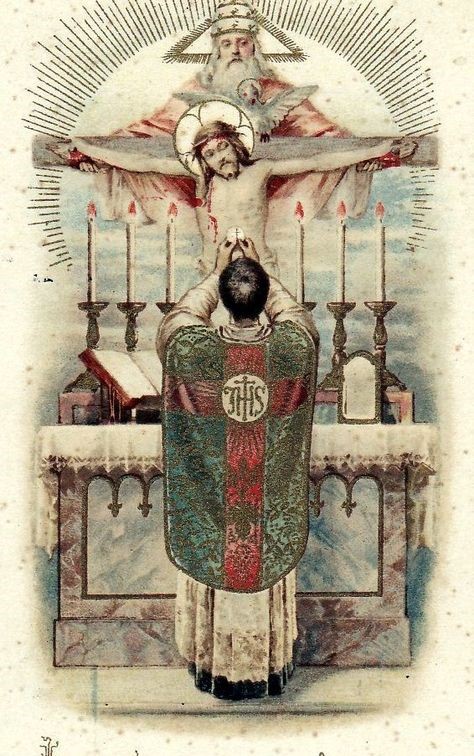
The privilege (and obligation) of the Roman Catholic is his or her ability to be really and truly present at that same Sacrifice that took place two-thousand years ago while at each and every Holy Mass.  The Mass is not a mere supper nor is it a community gathering for entertainment purposes; it is quite literally the unbloody unveiling of the Sacrifice of Christ that perpetually restores mankind to the Father and reorders the cosmos.  Our Lord intended to have this Sacrifice perpetuated in memory and for the application of its graces in every Church throughout the world until its consummation.

The incredible aspects of the Aztec sacrifices lay in the unlikely resemblance they had to Christian worship.  The Aztecs would paint and dress up their sacrificial victims to look like the gods to whom they were offered, so that they would have the “face of a god”.  They would even say that these victims were in the image of gods, so when they were killed it was like a god himself was offered up as a sacrifice.  As Catholics, we believe that “the Son is the image of the invisible God”, who offered Himself as a Sacrifice (Colossians 1:15).  The Aztecs believed they had to offer these finite sacrifices on a daily basis to appease the gods, whereas Catholics celebrate the One Infinite Sacrifice unveiled at Holy Mass every day.  With the guidance of brave Spaniards who risked their lives for the Glory of God, the Aztecs and other natives of Mexico ended up converting to Catholicism in rapid numbers because of these similar concepts in worship.  Instead of eating the legs or arms of the human sacrifices at the bottom of the temple each day, they could now eat the flesh of the God Who died in our place at Holy Communion.    

“True man. He bore the guilt of all humanity. True God. His Sacrifice alone had the efficacy to atone for all sins.”

Although it cannot be emphasized enough that the Aztec sacrifices were Satanic acts of wicked savagery, we can clearly see that their impulse - in some sort of odd way - was correct, just carried out incorrectly.  The rational faculty of man enables him to come to profound truths regarding God and His creation, as was seen with the Aztecs. Yet, in order to enter into communion with God, it is necessary that man submit to those Truths Divinely Revealed that cannot be reached by human reason alone.  The Aztecs and other natives converted to Catholicism in rapid numbers, largely because they recognized the Christian faith as the true end of some of their inclinations.

Unapologetically You

You know when you’re singing along to the radio and the words flow from your lips without a single thought? Perhaps you stop to think for a moment, then realize you just shouted an entire line of curse words with your mom sitting beside you. The same seems to go for the Mass as well: an entire group of people, standing in unison reciting the prayers, sitting, responding, maybe whispering along with the opening hymn - but are you really thinking about what you’re doing, or are you going through the motions? We repeatedly praise, worship, and direct our hearts towards our Heavenly Father; we literally speak the words “Our Father,” so why are we denying Him? As Christians, we must never be ashamed of Christ; we must never refuse the gift of faith given to us through Christ’s eternal single sacrifice.

What does that even mean? Now is when most get defensive, explaining how they go to Sunday Mass every single week (maybe except when the Super Bowl is on because… it’s the Super Bowl!) [Note: eyeroll]. They explain how they went to Catholic school for their entire lives; how they were baptized minutes after being born as if their 4-hour-old selves quoted the word of Peter: "Repent, and be baptized every one of you in the name of Jesus Christ for the forgiveness of your sins; and you shall receive the gift of the Holy Spirit" (Acts 2:38). That’s not to be minimized, for it’s true that the blessing of the faith lies within us all. As such, this article isn’t to say that you aren’t doing enough, although that is probably true. Rather, this is to raise the question of denying Christ.

Think about your father. Would you ever deny that he is your father? No matter what your circumstance may be, each one of us has a dad. Even if you don’t know him, or if he is your very best friend in the world, human beings feel a distinct connection to their biological parents. These two people, by the grace of God, created you in His image. Even if he fails to take into account your delicate sensibilities (yes, speaking from experience here...), one does not deny his or her father. Even if you don’t like him, chances are that you somehow love him. Surely, there is a difference between those two verbs.

Now, think of the last time you were standing in Mass, or most any Christian service for that matter. Perhaps without even thinking, the words begin to flow from your mouth: “Our Father, who art in heaven, hallowed be Thy name…” It does not take a Bible scholar to note that we are not talking about our biological father in this instance; rather, we are talking about our Heavenly Father, the one who commonly goes by the name of God, or Dieu if you’re French, Dios if you’re Spanish, and so on. It’s like that time that you were singing in the car with your mom, not considering what the words meant but saying them nonetheless. Crazy, truly.

As someone that did not grow up in this world where we discuss the change of saying “and with your spirit” instead of  “and also with you,” I noticed everything right down to its most basic level. In other words: I questioned everything like I was a two-year-old child asking “why” about quite literally every part of the Mass. Why did that person just do a little bow there in front of that table? (Note: I soon find that we call this the altar.) Why did that one person go down on one knee before sliding into his seat? (Note: this one was hard to grasp at first because genuflection feels like a dying ritual, but one that should most certainly be preserved). Why did that girl hug me at the Sign of Peace, and how many people do I have to awkwardly look at and mouth “peace be with you” until the priest continues? Everyone was speaking English around me, but they might as well have spoken a made-up language, for I was lost.

Since I’ve come from the secular world, my first time attending a Catholic Mass freaked me out. I felt as if I entered into an entirely different world, and despite the fact that the Mass was opened with the words “all are welcome here,” I most certainly felt out of place. Why are people singing now? What was that word that everyone just said in unison? Why does that person kneel while that one doesn’t? All these questions (and, trust me, many more) raced through my mind - and not just at my first Mass, but sometimes to this day. I had this feeling that everyone around me knew was was going on… except me. I felt a vague sense of unease whenever I would go to Sunday Mass because of that feeling, but I still needed to identify why, after eighteen years of existence, I decided that now was the time to explore Catholicism. Arguably, I had gotten along just fine before (or so I thought), but in seemingly minutes’ time, I felt like I could not live; I could not breathe one more day without giving myself to this Church. Because of all this, I found myself sitting in the office of Fr. Hayes to discuss the conversion process.

Per my typical “all or nothing” attitude, I quickly found myself attending daily Mass, running (yes, physically running) from meetings to Theology by the Slice so I could listen to talks on the Old Testament or Saints and Superheroes, and having breakfast with friends to talk about the faith. I went and bought my own Bible, which turned out to be an amusing and interesting experience as I tried to find out which translation was “best”... and which color I wanted. With such a dramatic change in who I was and who it seemed like I was becoming, friends and others around me began to take notice and give their “advice” on my new lifestyle. I was taking it too far, they said. “Perhaps she’s going to become a nun?” others remarked. Those who don’t know what Holy Cross is were convinced I had been sent to Bible school. Rival voices crept in from all directions, poking at me and making me question if the decision I was being called to make through the grace of the Holy Spirit was the right one for me. These voices came from some of the people I love most, making my “choice” that much harder… but that’s the thing: this isn’t a “choice,” because if it were, I could have easily decided to step away from the Church and return to my previous life. That life, however, was far gone.

“Faith is not a one-size-fits-all, and it is therefore going to look different for each and every one of us.”

Not wanting to be perceived as weird or anything too far out of our idea of normal, I cut back. I sometimes skipped Mass altogether, ultimately suffering and only hurting myself through that choice. I would take my cross necklace off around certain friends for fear of judgement. I would make excuses as to where I was going at 9 P.M. on Tuesday night, because who goes to Mass on a Tuesday? The answer: a lot of amazing people. Sometimes I feared that the aforementioned breakfast conversations about age-old debates of the Catholic Church would get so loud that nearby tables could hear. Without even knowing, and certainly without desire, I began to deny Christ. It was not until I listened to a podcast by Fr. Mike Schmitz that I realized what I was doing. [Note: if you haven’t listened to Fr. Mike, get ready for some life changing material.] Simply put, Fr. Mike outlines, “to deny Jesus will always be the wrong thing to do.” As much and perhaps more, we must care for our souls to the same extent we care for our bodies. This entails nurturing your relationship with Jesus and never being afraid (or ashamed) to accept him as your Lord. It entails not only acknowledging, but responding to the voice - the Holy Spirit - that is guiding you from within.

Faith is not a one-size-fits-all, and it is therefore going to look different for each and every one of us. With that said, it is time for us to show no fear or shame in our worship of God, which will mean different things for different people. Do you feel the call to kneel at Mass at the preparation of the Eucharist even though no one else is? Kneel. Do you love celebrating the Mass by singing? Let’s even get you a microphone! Is your ideal Wednesday night characterized by some pizza and theological discussions on the faith? Go eat pizza and open up your mind. The point is this: there will always be someone who doesn’t approve of you. Unfortunately for us, there is no such thing as a “good Catholic,” for at the end of the day, sin is to the human being as sacrifice is to the Mass, as Jesus is to the highest form of love.

If I had to describe the purest form of liberation, it would be the idea of being unapologetically you, which includes a fearless, shameless, loving worship and acceptance of Jesus. We would never want to deny our fathers here on earth, so why is it okay to deny our Father in Heaven? If it is of the unpopular opinion, so be it. If it is “weird” to unapologetically accept the utter gift of faith that has been given to us, let us be weird. Let us liberate ourselves from the shackles of fear and disappointment and step into a new life of love. All we can give to the Lord is our complete will. Offer it up. Accept your faith. Embrace the gift of acceptance, liberation, and life. Witness of the Mass is not enough; rather, we are called to participate in Christ’s sacrifice on the Cross. The urge to deny Jesus will always come, but Fr. Mike gives us the only answer we may ever need: “[rival voices] can rob us of peace, joy, and Christ’s place in our heart. But to take courage, get up, Jesus is calling you.”

“As Christians, we must never be ashamed of Christ...”

Letter from the Editors: February 2019

Dear Reader,

Thank you for picking up the first issue of The Fenwick Review of 2019.  We hope you didn’t mind the wait!  

This year marks the Review’s 30th anniversary.  Three decades ago, our publication’s founders vowed “to publish a journal of opinion” in which they hoped “to provoke intellectual discussion and stimulate ideas.”  Here, in 2019, we hold true to the mission they instituted and aim to advance the values, principles, and ideas they so boldly defended.

In 1989, 30 years ago, The Fenwick Review was founded on the defense of traditional Catholic principles and conservative ideas in order to provide alternatives to the dominant campus ethos.  The contents of this issue hold true to that mission. In the wake of continued campus controversy and student protest, Professor Schaefer of Political Science offers his insights on last December’s ENGAGE Summit and the foundations of liberal education.  Mr. Buzzard and Mr. Rosenwinkel reflect on living the Catholic faith and acting as a man for others, respectively. Mr. Klinker comments on the role of sex in the present-day culture, and Mr. Pietro defends American exceptionalism through historical and contemporary political contexts.

Though there is no doubt that Holy Cross is a different campus than it was 30 years ago when this publication first hit the newsstands, The Fenwick Review and its mission remain imperative and our founders’ vision remains relevant.  We seek the best for Holy Cross and hope you can find something to enjoy, to ponder, or to reflect upon in the coming pages of this issue.

Seamus Brennan & Michael Raheb

Co-Editors-in-Chief


The Problem With Asking More

Despite its blatant contradictions to Holy Cross’s mission statement, to Jesuit values, and to the objectives of Catholic education, the College’s “Ask More” tagline is decidedly appropriate for the current state of the school.  Rooted in fallacies and dangerous inconsistencies, the now five-year-old motto is not only a direct source of the College’s intellectual and cultural decline, but it has also fundamentally distorted the College’s mission as an educational institution – whether those behind the motto acknowledge so or not.  Because of the “Ask More” motto and its inevitable philosophical consequences, Holy Cross has devolved, on an institutional level, from a campus of higher learning to a campus void of answers, a campus void of lasting knowledge, and a campus void of truth.

In February 2014, Fenwick Review co-founder Fr. Paul Scalia said in an interview that his experience as a Holy Cross student could best be summarized as “the constant questioning, but never the articulation of an answer.”  Scalia continued: “Once we say the purpose of a college is to ask questions, […] that’s a huge problem.” As Scalia rightly noted, the act of questioning innately presupposes an answer; interpersonal dialogue in and of itself – both formal and informal – is contingent upon the existence of truth and an underlying desire to reach it.  But that’s not how many Holy Cross professors and administrators are inclined to approach their lectures and class discussions. Holy Cross’s version of ‘asking’ is not based upon seeking the truth or reaching a final conclusion, but on needless exposure and experimentation for their own sake.

The College’s “Campus Life” webpage suggests that “deep exploration” and the “uncover[ing of] new perspectives” are valued above all else.  The Montserrat program’s webpage indicates the program “encourages engagement” and “fuels an enduring quest” for “growth.” The Office of Diversity and Inclusion purports “the best way to understand the world around us is to embrace the full spectrum of perspectives and life experiences.”  And the list goes on. Several courses and seminars I have taken during my time at Holy Cross introduced students to a wide assortment of “perspectives” and “experiences,” but never once sought to analyze or dissect them, to dig deeper, or to – dare I say – answer any of the questions professors so tirelessly pose.  A multitude of perspectives can be noble and worthwhile, but only when presented in a way that compares and contrasts them – in a way that acknowledges their flaws and their fine points and isn’t afraid to elevate one over the other, or cast one aside because it might fall short. When teaching their classes, it seems many Holy Cross professors are consumed with following endless roadmaps with infinite numbers of twists and turns, divergent paths, and no destination anywhere in sight. Just as roadmaps might be deemed useless if they fail to direct one to a final destination, the act of ‘asking more’ is fruitless and meaningless when answers are abandoned and truth is left unacknowledged.  Asking without any intention of answering can only lead one down an eternal rabbit hole of uncertainty, indecision, and emptiness.

Unfortunately, the College’s apathy towards truth is not limited to the classroom.  The administration and student offices have taken up similar methods: the bleak intellectual consequences of ‘asking more’ have bled over to other components of the school and have further exposed the fallacious nature of one of the College’s most highly touted marketing slogans.  The Foundation for Individual Rights in Education labeled three of Holy Cross’s policies and codes of conduct as “red light policies,” indicating they are guidelines that “clearly and substantially restrict freedom of speech.” In its Use of Information Technology Services policy, for instance, Holy Cross leadership states that “the determination of what is obscene, offensive or intolerant is within the sole discretion of the College.”  Its Code of Student Conduct for Emotional Abuse denotes that “emotional injury” – for which the College offers no reliable definition – is considered a violation of community standards. Four additional rules and guidelines are categorized as “yellow light policies,” which the Foundation describes as having the capability to “easily be used to restrict protected expression.”

For a college that prides itself on “asking more,” encouraging “engagement,” and promoting an “enduring quest” for “growth,” aren’t free speech restrictions of any sort antithetical to the school’s mission and branding campaign?  If the “power of a question and the door it opens” is truly the “fundamental idea” behind the Holy Cross experience, as the school itself asserts, why should the College have the right to silence students based on what it subjectively perceives as “emotional injury” or “intolerant”?  If all ideas and perspectives must be acknowledged and discussed on equal playing fields, what gives the supposed champions of ‘asking more’ a right to shut them down? Here lies the problem with the morally relativistic and multicultural lenses through which the College is entrapped: if truth does not exist or is not worth pursuing, why should Holy Cross administrators have the right to tell one that his “perspective” is wrong or intolerant?  If all “perspectives” are equally valid and worth exploring, then why aren’t some? Perhaps most importantly, how does censorship of “emotional injury” complement one’s “enduring quest” for “growth”? The College that insists exposure to a multitude of perspectives is the basis for intellectual and personal growth should not be the College that flaunts its “sole discretion” to determine what might not be an acceptable perspective.  One cannot logically direct a body of students to “ask more,” but only up until someone’s feelings are hurt.

The “Ask More” tagline aptly characterizes the general academic and cultural atmosphere on the Holy Cross campus as palpably self-contradictory.  Of course, not every professor or every class abides by this faulty approach: intellectual honesty and appreciation for truth have not yet been not entirely terminated from campus, but they seem to be lessening every new semester.  Catholic Jesuit education is built upon pursuit of the truth. Holy Cross’s own mission statement, ironically enough, calls for “a passion for truth.” When will we start living up to it?

Truth is not always easy.  The quest for truth can be distressing, onerous, and at times downright infuriating.  But that doesn’t mean it’s worth forsaking. The act of ‘asking more’ is noble, but asking must lead somewhere or to something.  A restoration of meaning, purpose, and value would lead to immeasurable improvement and would do infinite good for Holy Cross’s campus.  As St. Ignatius Loyola, founder of the Jesuits, wrote, “It is not much knowledge that fills and satisfies the soul, but the intimate understanding and relish of the truth.”  In order for Holy Cross to live up to its strong potential as a Catholic liberal arts institution, it must shift from the pursuit of knowledge for its own sake to the pursuit of knowledge for the attainment of what is true and what is good.  Like truth itself, Holy Cross is worth protecting. It is in seeking the answer, not the question, that we can open our minds, revitalize our intellect, and reach our potential as a campus of higher learning.

To Live the Faith of Our Fathers

There is a stirring hymn by The Reverend Father Frederick William Faber from 1849 which, titled “Faith of our Fathers,” commemorates the sacrifice of the English martyrs that were killed under the Tudor rule of Henry VIII and Elizabeth I during the establishment of the Church of England. The martyrs include notable saints such as Saint Thomas More, Saint Oliver Plunkett, and Saint John Houghton, O. Cart. The hymn was written for the audience of both English and Irish Catholics, whose allegiance was found in their shared faith and persecution by an unjust authority. Its lyrics speak of how our Catholic faith is “living still in spite of dungeon, fire, and sword” which serve to remind the listener that the Catholic faith has and will continue to overcome persecution because of its truth. When performed on an organ, it is sure to have “our hearts beat high with joy whene’ver we hear that glorious word.” It should also serve as a reminder that the freedom to celebrate the faith openly is a luxury won after centuries of martyrdom. So, what does this hymn have to do with us as Catholics?

To start, reflection on the title of the hymn itself is important. For Catholics with a strong baptized lineage, it serves to remind us that this is indeed the “Faith of Our Fathers” in the literal sense of ancestry. There is a sense of pride here in being able to look back in our family trees and find solace in knowing that we are not alone in our faith. For converts to the faith, it is still important to look back upon spiritual fathers in the sense that many of the men and women who endured martyrdom for Christ were converts. There is the connection in the pursuit of truth, for while the two are not related by lineage, they are related in the sense that they are baptized into the Body of Christ. In both senses, this is a title which pulls on the heartstrings to invoke a sense of connection and a bond that transcends time.

In its composition, in order to properly honor the memory of the martyrs, there were important messages to give to the reader. The lyrics touch upon how “Our Fathers, chained in prisons dark were still in heart and conscience free: how sweet would be their children’s fate, if they, like them, could die for thee,” a message that may seem unfitting or uncomfortable for our modernity. We are called to remember that sacrifice that our predecessors made for us to be free. While chained, bloodied and bruised, these phenomenal men and women did not see this as their end, but rather they held out hope for Christ. Their hearts were purely intentioned because they were willing to give up their lives for the truth that they could pass on to future generations. How sweet it would be for us to honor their memory by making our hearts and consciences free due to our hope in the salvation of Christ! The call to martyrdom is not something that we will likely have to answer, due in part to the sacrifices of others. How can we, who have the luxury of having daily masses free from violent persecution, possibly “die for thee?”

This call is answered in the hymn and it can apply to our modern lives. The hymn is overwhelmingly a message of Hope. It is hopeful that we as Catholics will “love both friend and foe in all our strife: and preach thee too, as love knows how by kindly words and virtuous life.” We are called to love our friends and our enemies, preach the Word of God, and live a virtuous life. All of those things are extremely difficult to do and through human error we are likely to fall. In our shortcomings, we are never alone. We have Christ, His Church, the Communion of Saints, and many more aspects of faith available to us. Though this road is difficult, we can become more and we are commanded to do a better job.

How can I, a Catholic in college, do a better job? To start, remembering constantly that this is a faith for which people have shed their blood. To honor of the faith of our fathers, we should act like the Church that we are baptized into is the truth for which people would die to protect. It is not something to which only partial attention should be paid; rather, all of our attention should be towards salvation through Christ. We should seek to live out a virtuous life, one that is set in the virtues of humility, kindness, temperance, chastity, patience, charity, and diligence. When we falter in our pursuit of virtue, rather than scorning the Church, we must be reminded of the Faith, Hope, and Love found in Christ. We will never be perfect - no human being is perfect - but we have models that we can strive to imitate.

It is not enough for one to say, “Oh I went to a Catholic school” or to say, “Well, I was raised Catholic” in order to claim some authority as to why he is out of line in his views. Catholicism is a living faith. It requires faith and works and for its members to do more than sit in a pew with half-attention once a week. We need to do better, and to do so requires dedication and a willingness to pursue something more than ourselves. When our Church has a history of individuals who selflessly gave up their lives with their last words being “Deo gratias” (thanks be to God) rather than denying Him, it is not enough that we call ourselves ‘Catholic’ and then proceed to give up Christ for the other 167 hours of the week. In our daily lives, let us try to be better and actually commit to the centuries of foundation set before us.

“Faith of Our Fathers” is a very classic hymn with a timeless message. It is important that we pay attention to the lyrics whenever we are fortunate enough to hear it during Mass. In our Church, we have both genealogical and spiritual Fathers that we can follow in order to model our Faith. Being Catholic is not easy, but we have been afforded some luxuries that were not previously available to those before us. We have governmental freedoms that allow us to avoid being put to death; surely we can take advantage of that and use our time to glorify God. It is time to rock the cradle enough for us to fall out of our habits and become like our Fathers, who only sought to preserve the truth so that future generations would be able to worship our Lord freely.

On the Relation of Feelings, "Demands," and Reason in Liberal Education

This past November 11, in reply to the student/faculty letter demanding that the College cancel classes for as long as a week in response to an alleged "hate crime" (as well as to other alleged but unspecified incidents of bias-motivated "hate and violence")—a demand to which the College administration acceded in part by canceling all classes and extracurricular activities for an afternoon so that students and faculty could attend a mandatory "Summit" to address the issues raised in the letter—I arranged for the following notice (slightly edited here) to be posted on my office door. (Since I am currently on sabbatical, I wouldn't have been in my office on that date, nor even, I suppose, expected to participate in the Summit, but I thought it essential to make a statement regarding the significance of the shutdown,)

I have not signed the letter asking the College to suspend classes on account of a reported hate crime. This is because I believe the primary purpose of a liberal arts college is to engage in the pursuit of learning, through classes and the study of readings that are of lasting importance. So far as I know, Holy Cross maintained a regular class schedule even during the Second World War, when many of our students and recent alumni were abroad fighting for our country. We cannot afford to set a precedent of calling off classes whenever faculty and/or students are upset about some particular incident, however ugly it may have been. (I say "may have been" because the circumstances of this incident have not been made clear to the faculty, the student body, or the public at large.)

The foregoing statement elicited a remarkable response from a student I have never met, which she emailed to a dozen or so College administrators from the president on down, as well as to the chair of my department:

As I was passing through the hallway in Fenwick, I saw a very concerning letter from Prof. Schaefer posted outside of his office door. I felt like this letter is very inconsiderate and insensitive as it minimizes past and recent events that have been impacting many students, faculty and staff on our campus. It makes me feel extremely uncomfortable, especially coming from a professor, because I feel like this is disrespectful to those who have been affected by these events. I noticed on the ENGAGE Summit schedule, the Political Science department is hosting an Open House, and as a faculty member that represents that department, what he mentions in his letter contradicts the message the department is trying to put forth for tomorrow in their session.

Last year, I was the student that found and reported a swastika that was in one of my classrooms. It is extremely upsetting and disheartening to be in this position, as a student, to have to make reports like this–  but especially when they are coming from our own professors. Thank you.by [sic].

According to a report subsequently issued by the Office of Public Safety, it appears that no proof has been found of the alleged incident that provoked the mass letter calling for a suspension of classes. But whether or not the incident occurred is beside my present point. What centrally concerns me—as it did when I posted the "offending" message on my door—is the misunderstanding of the function of a liberal arts college, or the very meaning of liberal education, that is embodied in the original petition that led to the Summit; in the resultant cancellation of academic and extracurricular activities; and in the student letter I have quoted.

To anyone old enough to have been in graduate school during the late 1960s, as I was, the cancellation of classes has an ominous ring. That was the era in which students forcibly shut down college campuses, sometimes occupying academic buildings, even with weapons, for the sake of demonstrating their opposition to the Vietnam War, for racial "causes," or for other political agendas. (This occurred, most famously, at Harvard, Columbia, and [sadly for me] my own undergraduate alma mater, Cornell—where a supine University president was photographed squatting on a podium floor, soda can in hand, while a student "activist" railed at him before a large audience—this in preparation for the University's surrender to demands that punishments for rioting students, including those who had occupied the student union with guns, be canceled.) To those who possess some historical memory, the surrenders also recalled the sacrifice of the pursuit of learning to a radical political agenda that destroyed German universities in the 1930s.

By contrast, I am proud to say, my graduate alma mater, the University of Chicago, refused to suspend classes, or allow those who occupied the administration building to go unpunished. This isn't because many or most faculty didn't agree with the political beliefs of the protestors—regarding the war, race relations, etc.—but because at Chicago, then and now, the pursuit of learning is sacrosanct.

In this light, what is striking about the student's response to my notice is the expectation it exhibits that all professors (as well as students and administrators, presumably) should suspend their joint pursuit of learning, just in order to accommodate her (and other students') feelings of distress. If a professor's daring to dissent from the demand that classes be canceled makes her "feel extremely uncomfortable," I fear that Holy Cross has poorly prepared her to face the much more strenuous tribulations that adult life is likely to hold. To say that she "feels like" my dissent "is disrespectful" exhibits a significant misconception of what "respect" means, or to whom it is properly owed. Since when is it the job of professors to accommodate their students' "feelings," justified or not? How does she react if she is assigned a book in class that she disagrees with? (Does she require a "trigger warning," if not the removal of the offending text?)

The proper function of liberal education, as understood from as far back as Plato and Aristotle through such nineteenth-century champions as Matthew Arnold and John Henry Newman (and in the twentieth century, University of Chicago president Robert Maynard Hutchins), isn't to accommodate learners' feelings, but to challenge their received opinions or prejudices on the basis of rational arguments and free debate. Apparently, none of the letter writer's teachers thus far have got this message through to her—perhaps because they themselves, like the Baby Boomer protestors of the 1960s (or their predecessors, German youth of the 1930s) don't really believe in the superiority of rational thought to political advocacy based on mere emotion. If this is so, then they have been failing in their vocation.

(As an aside, I must observe with great regret the egregious recent discoveries of individual faculty sexual misconduct towards students, two of which have recently been acknowledged by the College administration. In that regard the third of the complaints submitted by "@sexualassaultonthehill" subsequent to the Summit urgently merits firm administrative action—although not another suspension of classes that would only divert attention from the real problem. Nonetheless, the fact that the complaints are listed as "demands" exemplifies a distorted understanding of the proper relation of students to College faculty and administrators as a whole—eerily reminiscent of the assaults on Chinese professors and teachers in the 1960s under the auspices of the government-sponsored, terrorist "Cultural Revolution." Additionally, the sixth "demand"—that the College "protect" self-identified student "survivors" from Secretary of Education Betsy Devos's proposal that accused perpetrators of sexual abuse "be able to hire a separate investigator to cross-examine" their accusers—bespeaks an ominous disregard for the Anglo-American tradition of due process of law, recalling the Salem witch trials. Will administrators and faculty have the backbone to stand up against such lawlessness?)

I close this essay by mentioning that as a Jew, I would have had far more reason than the letter writer to be offended or even upset at the discovery of a swastika on campus. However, it would never have occurred to me to respond by demanding that classes be suspended in consequence. To do so would play into the hands of those who seek to suppress rational debate, as well as respect for legitimate differences of opinion. (On the other hand, judging from my long acquaintance with Holy Cross students, I would guess that the swastika was far more likely a stupid prank provoked by the College's ever-increasing barrage of "multicultural" indoctrination than a reflection of Nazi sentiment.)

I earnestly hope that the suspension of classes is not an event to be repeated. And I urge the letter-writer to take some challenging classes in which classic, difficult texts— philosophic, literary, historical—are read closely with a view to understanding what their authors have to teach us, rather than judging them by the standard of our own pre-existing "feelings." What else is liberal education—the education that is supposed to equip a human being for genuine freedom, with reason governing rather than serving the passions, and with respect for the rule of law—for?