
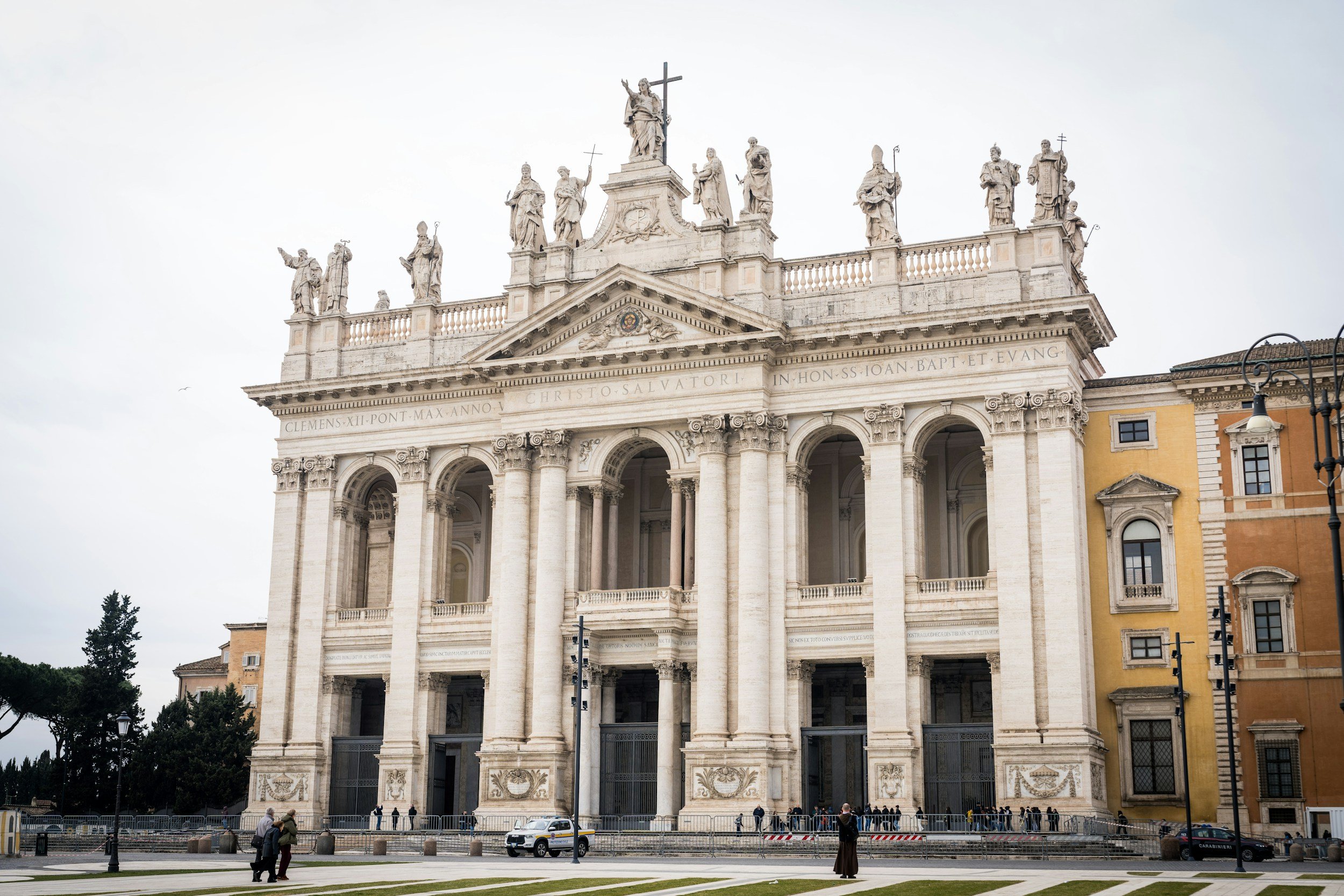
During the liturgy, the Christian faithful recite the Nicene Creed. A central part of this creed is the affirmation of the Four Marks of the Church, proclaimed when the faithful say they believe “in one holy catholic and apostolic Church”, which was added at the First Council of Constantinople. These markers hold the depth of what constitutes the primary authority of the faith, revealed in the councils and being in Communion with the true body of tradition that was revealed by God through Christ and received by the Apostles. The Triune markers of the Church are what identify Her as the one, sole, and true Body of Christ. They reveal where the Triune God is able to be truly present to the fullest extent in the revealed Word.
Unity is a both visible and invisible sign of the catholicity of the Church. The essence of the concept can be described by Paul in 1 Corinthians 10:17, where he writes “[b]ecause there is one bread, we who are many are one body...”. Saint and Church Father Cyprian of Carthage uses a fitting analogy in his work On the Unity of the Church, writing, “The Church is one, which is spread abroad far and wide into a multitude by an increase of fruitfulness... just as the sun has many rays but one light.” Many times in the modern ecclesial landscape schismatic behavior is witnessed over changes with regards to the Liturgy. Both Paul and St. Cyprian show that this is a fruitless cause for concern, as the Catechism of the Catholic Church describes that “The diverse liturgical traditions or rites, legitimately recognized, manifest the catholicity of the Church, because they signify and communicate the same mystery of Christ.” (CCC 1208). The Novus Ordo liturgy is no less than the Latin Mass of the 1962 missal, nor is it less than the Eastern rites, as they can all ascribe to sound past teachings of the Church in all aspects of worship. Paul describes that there is “one bread” that serves as the Eucharistic unity of the Church as a primary meaning of his epistle. A secondary meaning exists, however, as Eucharistic communion has doctrinal implications. For there to be sacramental unity, there must exist a shared faith. Separating the Eucharist from doctrinal unity would mean to separate Christ’s teaching of one Faith and one true Church. “The celebration of the Eucharist, however, cannot be the starting point for communion; it presupposes that communion already exists...” (cf. Ecclesia de Eucharistia (Pope St. John Paul II, 2003), §35).
The Gospel of Matthew calls for the Christian to “[b]e you therefore perfect, as also your heavenly Father is perfect” (Matthew 5:48). Even in the Canon of the Old Testament, the Lord says to Abraham, "[w]alk before me, and be blameless" (Genesis 17:1). Sanctity is a defining process that brings a sinner closer to unity and oneness with God through Theosis. The Universal Call to Holiness is what is given to the soul upon its Baptism. This call is present for all the Baptized using the Triune formula, and is dependent on the continuing process of Salvation for a soul to complete in its entirety. It is important to note here that the condescending God lowers Himself to that of the level of mere mortal human sinners. Thus, the Salvation in this context is through the faithful who have been blessed by the presence of the Gospel in their lives. The Catechism teaches that “[t]hose who, through no fault of their own, do not know the gospel of Christ or his Church, but who nevertheless seek God with a sincere heart, and, moved by grace, try in their actions to do his will as they know it through the dictates of their conscience—those too may achieve eternal salvation” (CCC 847). Continuing, if God became man to free us from the bonds of sin, then thus we are made to become like God through holiness in our lives through faith and works. Salvation is not a single moment or revelation, although the process to salvation can begin with a moment of defining Grace, but it is the continuity vocation that the Universal Call to Holiness entails. The primary method of achieving said Call is through the Church. This is both through Her Sacraments but also in the various devotionals to the Triune God and veneration of the Saints who have become holy themselves that exist in the faithful. Emphasizing the Baptism, Church Father St. Clement of Alexandria wrote in Book Seven of the Stromata “The baptized person is illuminated, he is adopted as a son, he becomes holy and righteous.”
The Apostolic marker of the Church is most visible in the Sacrament of Holy Orders. Scripturally, it is centered in the Gospel (specifically, the Great Commission). In Matthew 28:19-20, Christ orders his disciples to “[t]herefore go and make disciples of all nations, baptizing them in the name of the Father and of the Son and of the Holy Spirit, and teaching them to obey everything I have commanded you.” St. Irenaeus writes in Book 3 of Against Heresies, “We are in a position to enumerate those who were appointed bishops in the churches by the apostles... and to show the succession of these men to our own time.” The ecclesial concept of Holy Orders itself is in and through Christ and his earthly ministry. It is the fulfillment of both of the aspects of the Great Commission. The first aspect is the order of the Christian faithful to make disciples themselves, guiding others to the Truth of Christ in His Church along with the cleansing and Christening of the soul in Baptism. The second aspect is what happens as a result of the disciple being created, focusing on the Universal Call to Holiness discussed previously. Religious life, particularly mendicant orders such as the Franciscan family, Dominicans, and Jesuits, whose unique charism each seek to build disciples and form them the ways of Christ. For the Franciscans, this is focused primarily on the materially poor. For the Dominicans, the spiritually poor. For the Jesuits, it is a combination of both materially and spiritually poor through missionary work and education in the Faith. Educational apostolates serve both aspects of the Great Commission, making disciples by calling students to Baptism or the deepening of their current faith. Those whose souls have been permanently marked by Christ in the Sacrament of Ordination are called by Him to follow and emulate Christ through a variety of means, which can be simplified to both growing and guarding the flock of Christ. While examples of Religious Priesthood show specific charisms of the following of Christ in the way of a particular Saint or Blessed, the Diocesan Priesthood in itself maintains what is perfectly captured in the life of Saint John Vianney, a diocesan priest in many parishes in Ars, France. Pope John XXIII declared him the patron of the holiness of parish clergy. His life was marked by a particular attention to bringing about radical spiritual transformation through the visible signs of the Grace of Jesus Christ in the form of the Sacraments, particularly the Most Holy Sacrament of the Eucharist. The sacramental role of those in Holy Orders in the Apostolic marker of the Church allows for the deification of the faithful through the sacrifices that they offer in persona Christi.