
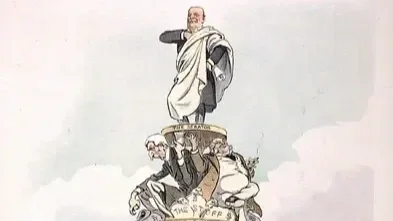
In The Republic, Socrates proposed the notion of a tripartite soul: that the soul has a rational, a spirited, and an appetitive component which, properly regulated, provides for balance in one’s life. The city too features this division: the rational class, the spirited class, and the appetitive body. As a republican government, the U.S. has lost its spirited class. The Senate, our most thumotic organ of civil government, no longer functions as the Founders envisioned. The 17th Amendment rang the death knell to the representation of states, and subsequently to federalism itself.
The Senate’s mode of election was meant to provide a check on democracy. Article I of the Constitution provided that the legislatures of each state would choose two senators, and the governor would temporarily fill vacancies during recesses [1]. As such, each senator was directly accountable to his state, safeguarded by the structure itself. The Senate would then provide direct representation to the states, as states, with the interests particular to those governments. In the national legislature, the people would have direct representatives through the House of Representatives—a more responsive body by its mode of election—but the Senate would balance out the sea of interests to derive state policies. Together, the two would marry responsiveness to prudence.
A democratic fervor during the early 20th century undid this compromise. Prominent populists, then progressives, attacked the institution as corrupt, geriatric, and undemocratic. There were certainly problems: senate elections often deadlocked the legislatures, high-profile instances of corruption, and the civil war undermined belief in state autonomy. This became such an issue that President Wilson, when running for office, campaigned on the direct election of senators, proposing that the problems of the republic would always be settled through more direct representation [2]. However, this injection of democracy undermined the central virtues of our republican system.
The two problems progressives campaigned on are worthy of discussion, the third was more so a sentiment. Legislative deadlocks used to be more common (seventy-one between 1885 to 1912) [3], but for good reason: our system is meant for effective, not instant, government. Additionally, the deadlocks would not have been so severe had Congress not demanded priority through part of the Civil Rights Act of 1866 [4]. It is better to have a proper representative than one who works against your interests. Imagine a parallel circumstance: it is roughly analogous to if a higher power ordained that the U.S. Congress could not pass another bill until the government balanced the budget, or sorted out the abortion issue, or enacted universal healthcare. Certainly each of these issues are worthy of our attention, but that is Congress’ discretion—we would be right to fear the faults of an expedient solution. In effect, this is what the Civil Rights Act of 1866 did to the states. Similar to the 17th Amendment, the national government abridged the respect due to the states in a dual federalist system. The Senate, rightly, gets to choose which senators to recognize, but how the states come about that should be at their discretion as local representatives.
Likewise, instances of corruption poisoned the well. In an era of populism and fervor for the everyman, the generally older, wealthier, and educated statesmen of this body fell under suspicion. It did not take much to bring the whole body, and their electors, into question. Montana Senator Clark resigned in 1899 for having bribed the state legislator [5], and Illinois Senator Lorimer was expelled in 1912 after news broke of his own bribery campaign [6]. But even this problem was exaggerated; between 1789 and 1909, of the 1,180 senators elected, only seven were denied their seats [7]. Yet, even these instances demonstrate that the system worked: the senate was preserved and those who attempted to subvert their state’s representation were ousted. But public pressure mounted, and in 1912, it took only 11 months to ratify the 17th Amendment.
However, the cure proved more potent than the sickness. State representation perished, and the Court tries to preserve its corpse on ice. As a result, we have an overreaching federal government, an activist judicial body, difficult nominations, and a citizenry who cannot care for their local politics.
Ultimately, the ratification of the 17th Amendment subverted the 10th, reducing the reservation of state power to a mere tautology; “all is retained which has not been surrendered.” [8] The U.S. Congress gained an unchecked influence contrary to the states’ plenary power: the complete legislative authority states have over themselves unless stated otherwise by the Constitution. Under this new compact, a multitude of issues arose over the national firearms policy, the drinking age, the commerce clause, labor laws, etc. Congress became a government, not of enumerated powers, but of justifiable power. Once the Senate was no longer beholden to the direct will of their states, they lost subservience to its interests—especially of deferring to subsidiarity. As Justice Thomas would later highlight, “when the people of Georgia pick their representatives in Congress, they are acting as the people of Georgia, not as the corporate agents for the undifferentiated people of the Nation as a whole.” [9] It is no wonder we arrived at an unduly hawkish Senate, a national policy of hammers on local nails, and an unreasonably high drinking age. Without the express direction of their legislatures, the Senate becomes lost: discerning national, populist appeal instead of the prudent, long-term interests of their constituents
The judicial branch, then, for more than one hundred years, has been attempting to reenergize the corpse of state sovereignty. What authority the amendments originally gave, the Courts have been trying to grant back to the states, including restricting Congress’ use of the Commerce Clause [U.S. v. Lopez (1995); U.S. v. Morrison (2000)]; preserving state purview of labor laws and manufacturing [Hammer v. Dagenhart (1918)]; preventing the commandeering of state resources for federal purposes [N.Y. v. U.S. (1992); Printz v. U.S. (1997)]; and undoubtedly, many more landmark cases. These are concerns the political process our government was designed for; they were never meant to be left to the decision of nine lawyers. Yet, it becomes apparent why judicial nominations are now so controversial: they matter more [10].
Our Founders architected a system built on checks and balances, which was safeguarded by the structure of its branches. Now, for more than a century, we have operated without those safeguards, and without proper state representation. Federalism is the key. Without federalism, this whole system limps about, swaying left and right, attempting to keep steady without the support of its familiar walls. With the hindsight of more than a century’s time, Senator Root’s critique is all the more prescient:
The proposed amendment is simply to enable the people of each State to escape from the performance of the duty of electing a Legislature that can be trusted. Are we prepared to abandon the performance of that duty? Are we to assume that our State Legislatures must necessarily and for all time be unfit to represent the people of the State? If so, what becomes of the government of the State? Is that, with all its multitude of important duties, to be left unfit? If any State Legislature cannot now be trusted, the true reform would seem to be in the direction of selecting the Legislature.
For all such reasons, I propose we repeal the 17th Amendment.
End Notes
[1] U.S. Constitution, art. 1, sec. 3; “The Senate of the United States shall be composed of two Senators from each State, chosen by the Legislature thereof….the Executive thereof may make temporary appointments…”
[2] “First Words: Woodrow Wilson, March 4, 1913 | Miller Center.” December 27, 2016. https://millercenter.org/issues-policy/governance/first-words-woodrow-wilson-march-4-1913.
[3] Ralph A. Rossum, Federalism, the Supreme Court, and the Seventeenth Amendment: The Irony of Constitutional Democracy (Lanham, MD: Lexington Books, 2001), 191.
[4] Ralph A. Rossum, Federalism, the Supreme Court, and the Seventeenth Amendment: The Irony of Constitutional Democracy (Lanham, MD: Lexington Books, 2001), 185.
[5] United States Congress, “CLARK, William Andrews,” accessed September 26, 2026, https://bioguide.congress.gov/search/bio/c000454.
[6] United States Congress, “LORIMER, William,” accessed September 26, 2026, https://bioguide.congress.gov/search/bio/L000444.
[7] Ralph A. Rossum, Federalism, the Supreme Court, and the Seventeenth Amendment: The Irony of Constitutional Democracy (Lanham, MD: Lexington Books, 2001), 185.
[8] Justia Law. “United States v. Darby, 312 U.S. 100 (1941).” Accessed September 23, 2026. https://supreme.justia.com/cases/federal/us/312/100/.
[9] Justia Law. “U.S. Term Limits, Inc. v. Thornton, 514 U.S. 779 (1995).” Accessed September 23, 2026. https://supreme.justia.com/cases/federal/us/514/779/.
[10] “Changes in Supreme Court Appointments—Fewer Justices, Longer Terms, More Contentious Confirmations.” Brookings, n.d. Accessed September 25, 2026. https://www.brookings.edu/articles/changes-in-supreme-court-appointments-fewer-justices-longer-terms-more-contentious-confirmations/.
Image Courtesy of Puck Magazine, “the Making of a US Senator” 1905.