
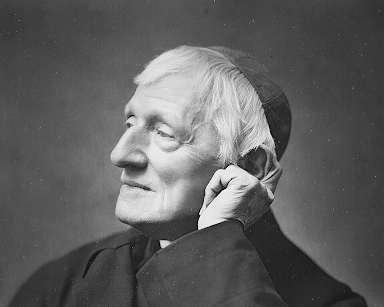
On July 31, 2025, Pope Leo XIV named S. John Henry Cardinal Newman a Doctor of the Church and co-patron of Catholic education, along with S. Thomas Aquinas. A former Anglican minister, he became a hallmark of the Oxford Movement. This movement, through the publishing of tracts (small pamphlets used for religious instruction), the movement sought to recover Catholic elements of the Church of England. The movement manifested itself across global Anglicanism. Anglican ministers began to shape their liturgies to mirror the traditional Catholic Mass. This included many outward signs such as vestments, missals, and high altars. Yet, Newman, while in Rome, fully understood that it was the spiritual depth of interiority, combined with an authentic development of doctrine, that was the true deposit of the Christian faith. He had begun distinguishing these ideas during his final years as an Anglican. After converting in 1845, he founded the Birmingham Oratory in 1848, part of the Congregation of St. Philip Neri.
So, why the oratory? In the sixteenth century, St. Philip Neri developed a center of informal spiritual development, combined with vocal prayer and hymnody, at the Roman church of San Girolamo della Carità. During his time in Rome, from 1846 to 1847, Newman was ordained to the priesthood and given permission to establish the Birmingham Oratory by Pope Pius IX. The Birmingham Oratory describes the apostolate of an Oratorian as “that of the threefold ministry given to the Apostles: prayer in common, the administration of the sacraments, and the daily Word of God. The virtues especially cultivated by an Oratorian are charity, submission of the individual’s will to the collective mind of the community, and loving to be unknown” [1]. In other words, Oratorians strive to lead a simple priesthood with informal bonds of charity. They seek humility, sound doctrine, and a strong discipline to the sacraments.
Efficacious homiletics are evident in the life of Cardinal Newman as an Anglican. His eventual conversion to Catholicism was marked by his motto as a cardinal, cor ad cor loquitur, meaning “heart seeks to heart.” His Anglican sermons, preached at or before his time at Oxford, are beautiful and edifying, yet they have a clear academic and theological tone. After becoming Catholic, Newman’s homilies shift towards a more direct emphasis on the state of one’s soul. His sermons took on an extremely salvific focus during his period at the Birmingham Oratory. Newman writes in his collection Discourses to Mixed Congregations, “Now, one of the defects which man incurred on the fall was ignorance, or spiritual blindness; and one of the gifts received on his restoration is a perception of things spiritual; so that, before he is brought under the grace of Christ, he can but inquire, reason, argue, and conclude, about religious truth; but afterwards he sees it” [2].
Newman sought to not propagate Catholicism by diminishing it, or by attempting to turn it into a Christ-themed implementation of new age spirituality. Rather, he dove into the richness and traditions of the timeless apostolicity of Catholicism. Meditations and Devotions was compiled by Newman to foster a deep interior life for his readers, including novenas and meditations of various riches of dogma, such as the Immaculate Conception, Our Lord’s life, and the life of St. Philip Neri. Newman wrote in his Essay on the Development of Christian Doctrine, "A doctrine develops, but it must remain the same type of thing... [It is an] authentic preservation of type of what came before." Take the Immaculate Conception, dogmatized by Pope Pius IX in 1854 in the document Ineffabilis Deus. The freedom of Our Lady from original sin is apostolic and patristic; it can be seen in the writings of Justin Martyr, [3] among other Church fathers, and is tacit in the Synoptic Gospels. Newman’s theory is also a devotion to an internal development of doctrine, and the acknowledgement that his once-held view of a lifeless and static Anglican understanding of doctrine was false. The transition of the development of Newman’s understanding of the human fall, to the role of the Annunciation, towards the Immaculate Conception, is a true personal development. It is reflected in Meditations and Devotions when Newman writes, “we do not say that she did not owe her salvation to the death of her Son. Just the contrary, we say that she, of all mere children of Adam, is in the truest sense the fruit and the purchase of His Passion” [4]. This is what St. Philip Neri wanted for the priests of his Oratories and what the practice of an Oratory is: to approach doctrine, not by dilution, but through a renewal that is a transition from reason to personal sanctity.
End Notes
[1] "Vocations," The Birmingham Oratory, last modified October 16, 2019, https://birminghamoratory.org.uk/vocations/.
[2] John Henry Newman, "Discourse 9: Illuminating Grace," in Discourses Addressed to Mixed Congregations (London: Longman, Brown, Green, and Longmans, 1849).
[3] Justin Martyr, Dialogue with Trypho 100, in The Apostolic Fathers with Justin Martyr and Irenaeus, vol. 1 of The Ante-Nicene Fathers, ed. Alexander Roberts and James Donaldson (Buffalo, NY: Christian Literature Publishing, 1885).
[4] John Henry Newman, "Memorandum on the Immaculate Conception”
Babouba, Public domain, via Wikimedia Commons