
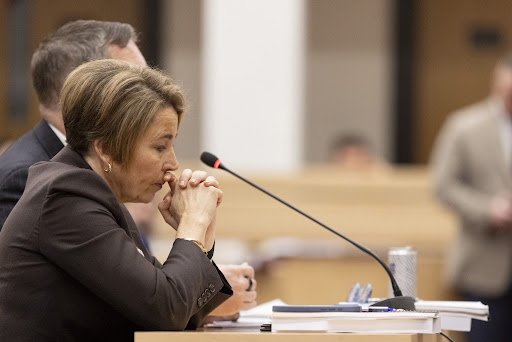
Maura Healey took office in January 2023 with a nearly $2 billion state surplus and a legislature entirely controlled by her own party, the most favorable hand any politician could ever ask for. She won that office by casting herself a natural heir to Charlie Baker's reputation of fiscal discipline and competent management. Nonetheless, four years later, and running for a second term against Republican nominee Mike Minogue, Healey has rapidly spoiled that inheritance. Her record as governor is one where she will talk about affordability while the state grows less affordable, and claim fiscal seriousness by begging the legislature for more money, all while failing to hold the legislature accountable.
The State of Massachusetts is the only state with a "right-to-shelter" law, and Healey's administration was blindsided by the Biden administration's failure to regulate border crossings, causing a shelter surge. Annual costs exploded from roughly $200 million to a program now approaching $1 billion a year [1]. Rather than budget honestly for the crisis, Healey's administration repeatedly lowballed the legislature, only to come back mid-year for bailouts. By mid 2025 the state was spending $3,496 a week to shelter a single family, which is more than the roughly $2,015 a week the median Massachusetts household earns. This governor, who ran on affordability, was in effect spending more per week on one sheltered family than a typical working family takes home. The working class family that elevated Healy to the governorship was now the same working family being left behind as the state began to spend more, and grow increasingly unaffordable.
The Springfield courthouse deal [2] shows the same pattern of mismanagement, when in July of 2026, the state's Division of Capital Asset Management awarded a $600 million construction contract that eventually converts into a lease, costing taxpayers nearly $2 billion over 40 years. This makes the Springfield courthouse one of the most expensive courthouses built in America to date. Additionally, typical bidding regulations— where the lowest and most competent bidder usually gets the contract— were sidestepped and the contract was instead awarded to a team that included a firm co-owned by the husband of U.S. Representative Ayanna Pressley (D), plus a state official who briefly held a personal stake in the winning bid before quietly stepping away under pressure. Those losing bidders sued, calling the process "irrevocably tainted." A fiscal watchdog group, MassFiscal Alliance, demanded Healey pause the deal and release the records. She refused both, insisting she "wasn't involved" and saw no conflict of interest. That is not the answer that a governor exercising oversight of her own government should be issuing to the people of the Commonwealth.
In November 2024, 66 [3] percent of Massachusetts voters approved Question 1, authorizing the state auditor to examine a legislature that had exempted itself from public records and open meeting laws for over a century. Healey claims she voted for it. Since then, House and Senate leaders have stonewalled every request for records by gutting the audit's scope in a House bill, and forced the auditor to sue her own government's leadership just to get a hearing. Through all of it, Healey has done essentially nothing: she has not publicly pressed legislative leaders to comply, has not said whether she would veto a watered-down audit bill, and, by her rival's account, she went a year and a half without even returning the auditor's calls. 72 percent of the Commonwealth voted for this, and the Democratic supermajority legislature is failing to address the concerns of their constituents, and the governor is failing her duty to enforce the law.
The Republican nominee, however, is Mike Minogue. Minogue is a West Point graduate, Gulf War veteran, and the former chief executive who spent nearly two decades running Abiomed, a successful, Massachusetts-based, medical company. His campaign has centered around the affordability and leadership crisis that the Commonwealth is currently facing. The Commonwealth is also no stranger to electing Republican governors in a majority Democrat-run state. Since 1990, Massachusetts has had five Republican governors, and only two Democrats. Healy’s campaign, though, presumably hoping to ride off the anti-Trump sentiment, has pointed out that Minogue has been a donor to the Trump Campaign in previous years. This then begs the question for the average voter in the Commonwealth: What is more important to your community? Is it the affordability crisis that is dividing communities and preventing the promise of social mobility, or is it politics? That question will be answered in November.
End Notes
[1] Gross, Samantha J. “Amid Migrant Influx, Cost of Running Mass. Emergency Shelter System Surpasses $1 Billion.” The Boston Globe, 30 July 2024, www.bostonglobe.com.
[2] “Massachusetts AG Moves to Dismiss Lawsuit over $2B Springfield Courthouse Project.” WWLP 22News, 2026, https://www.wwlp.com/news/local-news/hampden-county/massachusetts-ag-moves-to-dismiss-lawsuit-over-2b-springfield-courthouse-project/.
[3] Massachusetts Secretary of the Commonwealth. “Massachusetts Statewide Ballot Measures: 1919-Present.” Mass.gov, https://www.sec.state.ma.us/divisions/elections/research-and-statistics/balmresults.htm. Accessed 1 Oct. 2026.