
The Carthusian Order is an enclosed religious order in the Catholic Church. In June of 1084, S. Bruno was called by the Bishop of Grenoble to establish a desert hermitage. Bruno felt that the seclusion of the Chartreuse valley in southeastern France was suitable for monastic life. Soon after, Bruno established a second hermitage in Calabria, Italy. He did not leave behind a written rule. Rather, the Carthusian Order has passed down his unique encapsulation of both eremitical and communal (cenobitic) monasticism [1]. This article will introduce the life of Carthusian monks as well as analyze their very unique liturgical theology. The aim is for an application of their charism and liturgical posture into a devotion for the laity.
Carthusian monasteries, called Charterhouses (named after Bruno’s first establishment in La Grande Chartreuse), begin their “day” at eleven in the evening. This is when the office of Matins, followed by Lauds, is prayed. The Angelus follows. Between two and three in the morning, the monks are permitted to return to their cells for rest, before rising again at six. Following the second rising, the office of Prime and another Angelus is prayed, preparation for Mass follows. At eight, there is a Conventual Mass, or Mass in Community. Interestingly, the offices of Terce, Sext, and None, are prayed by each monk individually. The Carthusian prays three types of offices: the standard Office of the Carthusian Rite, the Office of the Dead, and the Office of the Blessed Virgin Mary [2].
The work for a monk depends upon the modality of his vocation. Monastic vocations to the Carthusian order are divided into two main categories in order to support the entirety of the Charterhouse. The cloister monks are ordained and can never leave their cells without permission, unless to attend the appointed times of the recitation of the office and Mass. While in their cell, cloister monks study and do work that is limited to either preparation for ordination, continuing education, or maintaining food and the landscape of their cell. The cell is not a singular room that might be found in Cistercian or Benedictine monasteries, but a small house with a workshop and garden [3]. St. Benedict himself addresses the need for manual labor and study in Chapter XLVIII of his Rule: “Idleness is inimical to the soul; and therefore the brethren ought to be occupied, at fixed seasons, with manual work and again at fixed seasons with spiritual reading: and so we think the hours for each should be arranged on this plan.” The lay brother monks mirror the cloister monks in that their life is marked by prayer and work. However, this work is done more to contribute to the collective physical existence of the Charterhouse itself. Examples of this work include cooking and facility maintenance. Lay brothers also live alone in cells, but with less utilities as they are not confined.
The Statues of the Carthusian Order describe the liturgy as “manifest[ing] in a special way the nature of the Church in which the human is directed and subjected to the divine, the visible to the invisible, action to contemplation” [4]. The Carthusian Rite can be originally found in the twelfth century. While Pope Pius V made adherence to the rubrics and propers of the Roman Missal required, the ancient Carthusian Rite was permitted due to its antecedence [5]. The rite itself derives from the bringing of the faith to Lyons by Ss. Pothinus and Irenaeus. Gregorian chant, interior devotion, and the physical manifestation of the Communion Rite form the basis of their communal participation.
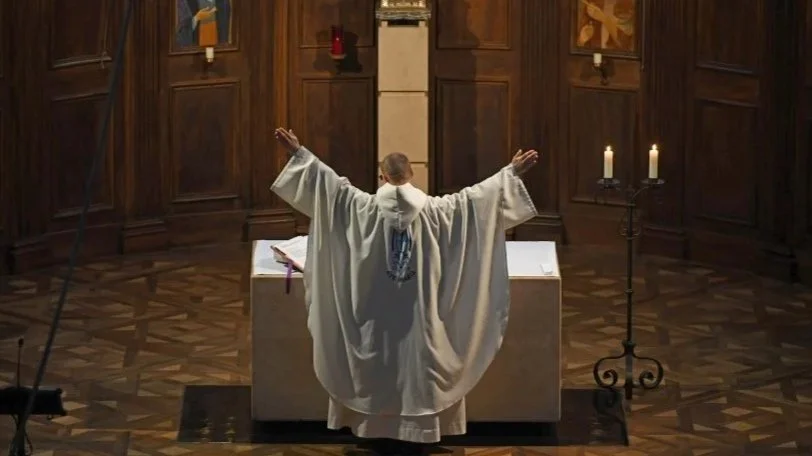
There are two bodily actions of the celebrant that part the Carthusian Rite. The first is the fully extended arms (compared to the lesser extension of arms in the Roman Rite) of the priest similar to that of the extended arms of Christ. While this gesture, the orans position, has been in the Church since the first century, the Carthusian Rite’s emphasis and feature of the posture is itself a representation of their own sacrificial charism [6]. These monks make a unique sacrifice of isolation, labor, and prayer both to the Church and to the Christian faithful in their daily intercession for them. The celebrant in his role as the consecrator of the Holy Eucharist extends this charism into the Eucharistic sacrifice.
The second distinguishing gesture is prostration. The celebrant and community prostrate during the description of the annunciation, during the creed, after the elevation, and at the priest’s communion. Emphasized here is an attitude of unworthiness and humility. The sacred mysteries presented at the Mass demand a direction of subjection towards God. This is an act of justice, a fundamental Thomistic principle, as addressed in Question 21 of the First Part of the Summa Theologica.
The Carthusians bear an impressive and self-giving witness in the Church’s monastic life. But how can the laity take after them in their own spiritual lives? It begins with the little things. Perhaps instead of going straight to your phone as a source of entertainment when sloth sets in, a rosary can be prayed, a spiritual book read, or mental prayer in the presence of idleness and silence observed. To follow the Divine Office, smaller and more pointed offices for specific devotions can be prayed. The Little Office of the Blessed Virgin Mary is very popular, but there are many other little offices. The website LOBVM.com recently compiled a digital publication titled A Big Book of Little Offices, included in this volume are offices as diverse as the Little Office of S. Thomas Aquinas to the Little Office of the Holy Cross. The day can be sanctified by dividing one’s school work or manual labor with prayer and spiritual reading. Creating a personal horarium or schedule with specific times dedicated to work, study, and prayer can aid in this endeavor. We can follow the advice of St. Catherine of Siena, who wrote in an advice to her confessor, “Build a cell inside your mind, from which you can never flee.”
End Notes:
[1] (Alban Butler, Lives of the Saints, 1995, 338.)
[2] (“The Day – the Carthusian Monks,” n.d. https://chartreux.org/moines/en/a-carthusian-day/.)
[3] (The Statutes of the Carthusian Order, Book II)
[4] (The Statutes of the Carthusian Order, Book VI)
[5] (Pope Pius V, Quo Primum (1570))
[6] (Tertullian, De Oratione, 14)