
On Thursday, February 5th 2026, one of the Holy Cross’ most committed stewards left Mt. St. James and entered into retirement at the Jesuit Campion Center in Weston, Massachusetts. I was fortunate enough to conduct an informal interview with Father Reiser on December 9th, prior to his departure. Throughout our discussion, there were many experiences which I found profoundly insightful. In this piece, I would like to most thoroughly cover the aspects of Fr. Reiser’s life which are most personal to him: his missionary work.
Fr. Reiser was born in Connecticut, the oldest of a family of ten. Early in his youth, the soon-to-be-priest felt a great calling, a “mystery” which continued to prompt an “intense feeling that… this is the calling.” God may have called him through his family’s experience in WWII: “[m]y father was in the Second World War, in the forces on Normandy. When he was in the war, he went to Mass regularly. There was something about my parents’ faith … I don't know what it was that caught me. But it really caught my attention.”
After completing eighth grade, Fr. Reiser would follow this sense into the St. Thomas Minor Seminary in Bloomfield, Connecticut. As part of a six year program, students at St. Thomas were nurtured through a thorough cultivation of classical studies. On why he ultimately chose the Jesuits, of all the Catholic orders, Fr. Reiser joked, “I was, as in the famous line from the movie Casablanca, misinformed.’ I thought they were all missionaries. Yeah, I said, ‘All Jesuits were missionaries.’ And what I wanted to do was become a missionary, to go on missions… The Jesuits were one of the largest missionary orders in the church. And that's all I knew. I did not know any Jesuits.”
One of the stories which drove his intense passion to go on missions came from the book These Two Hands. The story follows Father E.J. Edwards as “a missionary in the Philippines. And he was nervous about having contact with the native people because you never could tell what would happen. And he was afraid of contracting leprosy. [But] there was a fire in a village, and he realized that there was a woman in there who was a leper, who was unable to get out of her house. And so what he did, he went in and rescued her. The result was that he took her out, carrying her out, but his hands were scarred for the rest of his life. And I thought, ‘Well, could I do something like that?’ That was the question. And so I said, ‘Well, you don't know unless you try it.’ You know, who knows? But it stayed in the back of my head.”
His desire to teach the world eventually came to fruition. Over the course of his apostolic career, Fr. Reiser visited many countries: India, Nepal, Burma, Thailand, Sri Lanka, and Indonesia, to Paraguay, Peru, and especially Bolivia, which he visited many times. He wanted to understand how people in the Andean world heard the gospel. What difference does the Andean context make? What would an Andean theology look like?
“Andean theology,” Fr. Reiser explains, “would be theology as done taking culture seriously. How do you understand and express the gospel, along with, say, the culture of the Aymara people… For example, you've got a long, long tradition that goes back to the Inca. So there's some things that you won't understand unless you understand where this is coming from, you know? What do you do? Do you reject it out right and say, this is problematic for our faith? Or do you see how people from within a culture have appropriated the gospel in a unique way. So, for example, in the Andean world, the Pachamama is very important. What is it? Well, Pachamama is present everywhere. Pachamama is like a divine presence. It has to do with rocks and mountains and water and wheat, and so on. The Pachamama is the earth, but the earth as being generous. At any rate, if you're brought up in that culture, then the way you appropriate faith is different.”
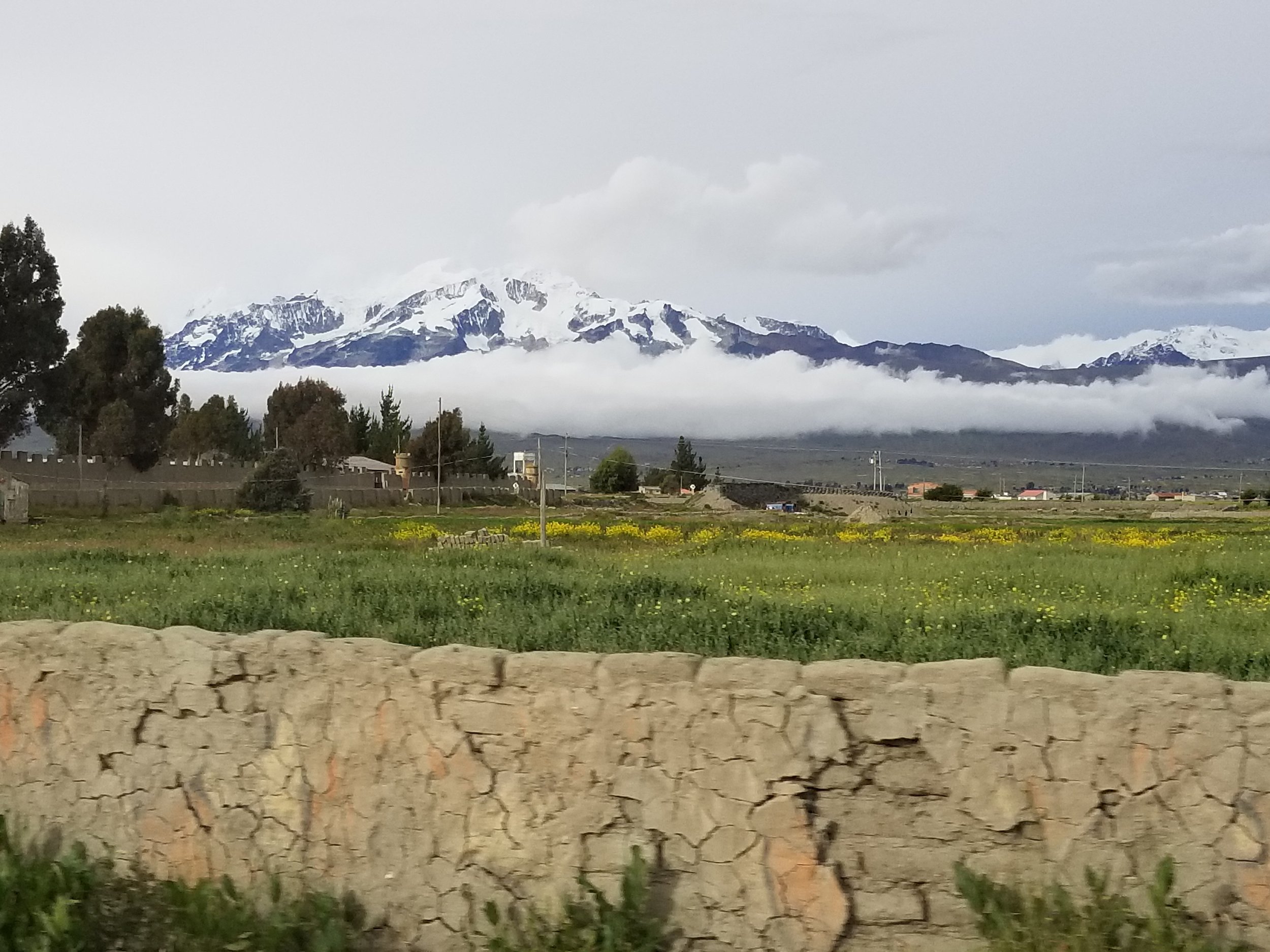
He continues with several anecdotes from his missions: “We were driving, one day, up La Cumbre in a jeep. We're at about 13,000, almost 14,000 feet. It's pretty high up. And there was a Jesuit driving, and we were going by that mountain, way at the top, and he made some kind of a gesture towards the mountain, and then we continued driving. I said, ‘Ricardo, what was that? What did you just do?’ And he laughed and said, ‘Oh, my mother taught us that when we were kids. You don't go past the mountains without asking permission.’ Now, it makes no sense if you don't grow up there. If you grow up there, it's all around you. You're living in the Andes. It's a different world. So, it's a very small example, but a place where you get to see the influence of a culture, a longstanding culture, and the way in which people live off of their faith today.
“And there's much of that. In the Andean world, community is extremely important. This is true at other places as well, but in the Andean world, just to make a decision, you do it together. And if you're not on board, we wait. We just wait until there is consensus, and then we go forward. In the Andean world, the idea that somebody could actually own a piece of the earth is odd. The Earth includes the bones of the Pachamama, and we happen to be passing through. You can't own property. So the whole Western idea of real estate… putting a title or a claim on a land is just something that’s foreign to them.
“One of the missionaries told a story, ‘The women would come in with their produce, and they'd be sitting outside selling things all day long, like oranges… And this one visitor came by and looked at them; she wanted to buy all the oranges. And the campesino—she was a campesino—she said, no, she wouldn't sell them all. And we said, ‘Why not?’ And she said, ‘Because, what will I do for the rest of the day? I have nothing else to do today.’” It's so different from our way of thinking.
Fr. Reiser continues to elaborate on how these experiences shaped his vocation. “As the years are going by, the different parts of the world that I've been able to see, have found [their] way into the things that I say in class. It's there. The same is true with being in ministry, as a Priest. That what's going on around you has an effect on who you are as a person. So we don't just preach. You preach what you believe. There's a special… grace that comes from the experience of preaching. When the effort is really to open up the scriptural words, to reflect on that with a group of people, a parish or a congregation. The people hearing not just you and not just the word, they're also hearing you as a person. And I would say that the people draw things out of us. Students do, too. Students draw things from teachers. If we reflect on what's happening, after a number of years, I think that we'd have to say that lots of what we have learned has been drawn out of us from our students.”
There is much more wisdom that came out of my discussion with Fr. Reiser; especially in regard to Holy Cross throughout the last fifty years, the role of education in public life, and of his domestic career and courses he has taught. However, in an effort to more fully disclose his experiences, I will render them in a later piece. This piece centered on his missionary work because it was evident that he cared deeply for these communities, and that was what set off his priestly vocation.
Pray for Father Reiser, his fellow Jesuits, and his family as he enters a new chapter in his life. He hopes to take advantage of his retirement to write, and to continue to engage with the communities of St. Bernard’s and St. Luke’s parishes in the Diocese of Worcester. None of us is ever a missionary by accident!